Thursday, 1 April 2021

Here are all of the Snapdragon 888 phones released so far https://ift.tt/30DgWlz

Samsung Galaxy S21 Ultra with Snapdragon 888
Credit: David Imel / Android Authority

Qualcomm’s new Snapdragon 888 chip is here, and it’s the powerhouse for most 2021 flagships. The chip promises a big boost in machine learning, photography, and more, so how do you get one for yourself? Here are all of the Snapdragon 888 phones that have been released so far, as well as a look at the best phones yet to come.

See also: The best Android phones

We haven’t seen too many Snapdragon 888 phones become available quite yet, but we’ll touch on all of the heavy-hitters. Be sure to check back often as we will update this list as devices launch.

Snapdragon 888 phones:


Samsung Galaxy S21 series

Samsung Galaxy S21 Snapdragon 888 phones

Credit: David Imel / Android Authority

Samsung wasn’t the first to announce a Snapdragon 888 device, but it’s currently your best to get the powerful chip in your pocket. The OEM launched its 2021 line of Galaxy S devices, including the Galaxy S21, S21 Plus, and S21 Ultra. You get top-of-the-line specs across the board, and the S21 Ultra has finally grown into its lofty title.

See also: Samsung Galaxy S21 buyer’s guide

The newest Galaxy S21 family is one of Samsung’s most affordable in the last few years. For example, the smallest Galaxy S21 starts at just $799, while last year’s S20 family kicked things off at $999. No matter which device you choose, you’ll get at least three rear-mounted cameras and Samsung’s colorful new phantom finishes.

However, you’ll only find a Snapdragon 888 chip on your new Galaxy S21 if you purchase the US-version. International variants come with Samsung’s in-house Exynos 2100 processor instead.


Samsung Galaxy S21 specs:

  • Display: 6.2-inch, FHD+
  • Chipset: SD 888 or Exynos 2100
  • RAM: 8GB
  • Storage: 128GB/256GB
  • Cameras: 12, 12, and 64MP
  • Front camera: 10MP
  • Battery: 4,000mAh
  • Software: Android 11

Samsung Galaxy S21 Plus specs:

  • Display: 6.7-inch, FHD+
  • Chipset: SD 888 or Exynos 2100
  • RAM: 8GB
  • Storage: 128GB/256GB
  • Cameras: 12, 12, and 64MP
  • Front cameras: 10MP
  • Battery: 4,800mAh
  • Software: Android 11

Samsung Galaxy S21 Ultra specs:

  • Display: 6.8-inch, FHD+
  • Chipset: SD 888 or Exynos 2100
  • RAM: 12/16GB
  • Storage: 128GB/256/512GB
  • Cameras: 108, 10, 10, and 12MP
  • Front cameras: 40MP
  • Battery: 5,000mAh
  • Software: Android 11

Xiaomi Mi 11 series

Xiaomi Mi 11 back against brick

Xiaomi edged out the Galaxy S21 family as the first Snapdragon 888 phone. However, it took a few months for the Mi 11 to launch outside of China. Even though Samsung had a slight head start, the Mi 11 packs an impressive spec sheet of its own and an impressive price tag to match.

See also: Xiaomi Mi 11 review: One cool customer, but is it a Galaxy S21 killer?

You’re looking at a large, 6.81-inch display, as well as a powerful 4,600mAh battery and blistering 55W fast charging. Xiaomi also chose a triple camera array to lead the charge, topped off with a 108MP main sensor. On the front, you’ll find a 20MP lens for all of your selfie-shooting needs.

Although the Xiaomi Mi 11 packs a Snapdragon 888 chip and Android 11 right out of the box, the phone runs on the MIUI 12 skin. It’s not for everyone, and you may find yourself looking for a launcher you prefer. However, the $749 starting price is a serious contender.

If you’re hoping to take your Xiaomi flagship even further, now is your chance. The company has finally pulled back the curtains on its Mi 11 Ultra, Mi 11 Pro, and Mi 11i, all of which pack Qualcomm’s Snapdragon 888. Xiaomi’s Mi 11 Ultra is the first in the company’s portfolio to feature an IP68 rating out of the box, and that’s just the tip of the iceberg.

Should you decide to grab the premium Mi 11 Ultra, you’ll immediately notice the massive camera bump. It houses a 50MP main shooter as well as two 48MP lenses, and the camera bump even offers a small 1.1-inch secondary display. 

You can also check out the Mi 11 Pro, which looks nearly identical to the base model in many ways. It also comes with an IP68 rating, and the 6.81-inch display matches that of the Mi 11. However, the Mi 11 Pro packs 67W wired and wireless charging, so you’re looking at a full boost in just over half an hour.

The final Snapdragon 888-powered member of the Mi 11 family is the Mi 11i. In fact, it’s a repackaged version of the Redmi K40 Pro Plus, right down to the last detail. You’ll find a 6.67-inch display, a solid 4,520mAh battery, and even a 108MP main camera on the back. It does miss out on creature comforts like an IP-rating and a telephoto camera, but it should be easier on your wallet.


Xiaomi Mi 11 specs:

  • Display: 6.81-inch, Full HD+
  • SoC: Snapdragon 888
  • RAM: 8/12GB
  • Storage: 128/256GB
  • Cameras: 108, 13, and 5MP
  • Front camera: 20MP
  • Battery: 4,600mAh
  • Software: Android 11

Xiaomi Mi 11 Pro specs:

  • Display: 6.81-inch, Quad HD+
  • SoC: Snapdragon 888
  • RAM: 8/12GB
  • Storage: 128/256/512GB
  • Cameras: 50, 13, and 8MP
  • Front camera: 20MP
  • Battery: 5,000mAh
  • Software: Android 11

Xiaomi Mi 11 Ultra specs:

  • Display: 6.81-inch, Quad HD+
  • SoC: Snapdragon 888
  • RAM: 8/12GB
  • Storage: 128/256/512GB
  • Cameras: 50, 48, and 48MP
  • Front camera: 20MP
  • Battery: 5,000mAh
  • Software: Android 11

Xiaomi Mi 11i specs:

  • Display: 6.67-inch, Full HD+
  • SoC: Snapdragon 888
  • RAM: 8GB
  • Storage: 128/256GB
  • Cameras: 108, 8, and 5MP
  • Front camera: 20MP
  • Battery: 4,520mAh
  • Software: Android 11

Redmi K40 Pro

Redmi K40 Pro Snapdragon 888 phone

Credit: Weibo/Redmi

Xiaomi’s subdivision, Redmi, has officially announced its K40 series, and we’re expecting a wide release shortly. The series features three total devices, though the K40 Pro is the main Snapdragon 888 option.

See also: Redmi K40 series announced

While we don’t know all of these new devices’ ins and outs, we know that Redmi is sticking with its incredibly affordable pricing model. The K40 Pro will stay safely below the $600 threshold, at least in China.

You’ll find the K40 Pro topped off with a 64MP camera as well as 8MP and 5MP lenses. It’s no slouch in the performance department, either, topping out at 8GB of RAM and 256GB of storage. We’ll be sure to provide more information once we have the K40 series in-hand.


Redmi K40 Pro specs:

  • Display: 6.67-inch, Full HD+
  • SoC: Snapdragon 888
  • RAM: 6/8GB
  • Storage: 128/256GB
  • Cameras: 64, 8, and 5MP
  • Front camera: 20MP
  • Battery: 4,520mAh
  • Software: Android 11

Vivo Iqoo 7

snapdragon 888 phones vivo iqoo 7

Credit: Banggood

The Vivo Iqoo 7 is one of the most affordable Snapdragon 888 phones, as well as one that you’re less likely to be familiar with. It’s not globally available quite yet, though the Iqoo 7 comes in quite a few interesting colorways. One of the unique options is a BMW racing livery.

You’re probably not buying a phone for its colors, so what are you getting besides the Snapdragon 888? Well, the device packs a large, 6.62-inch Full HD+ display and a crisp 120Hz refresh rate. You can also choose from 8 or 12GB of RAM and up to 256GB of onboard storage. Vivo selected a three-camera setup for its Iqoo 7, with a 48MP lens flanked by a pair of 13MP options.

The Iqoo 7’s battery isn’t the largest on the market at 4,000mAh, but the 120W fast charging can’t be topped. Vivo claims that it can get you back to 100% in 15 minutes, though it may not be the healthiest for your battery in the long run.


Vivo iQOO 7 specs:

  • Display: 6.62-inch, Full HD+
  • SoC: Snapdragon 888
  • RAM: 8/12GB
  • Storage: 128/256GB
  • Cameras: 48, 13, and 13MP
  • Front camera: 16MP
  • Battery: 4,000mAh
  • Software: Android 11

Vivo X60 Pro Plus

Vivo X60 Pro Plus back in sunlight

Credit: Hadlee Simons / Android Authority

Vivo isn’t sticking with just one Snapdragon 888 phone this year. The most powerful member of its X60 family is the X60 Pro Plus, and it’s tapped to feature Qualcomm’s powerful hardware. It’s a premium device, no doubt about it, and you’ll be able to grab yours in orange or gray leather.

Unfortunately, the X60 Pro Plus is still a bit tricky to track down. However, it packs a 6.56-inch Full HD+ display with a 120Hz display rate, so it’s worth looking forward to. Vivo also chose a 4,200mAh battery to keep you moving, and you won’t have to charge long at 55W speeds.

Perhaps the most impressive part of Vivo’s X60 Pro Plus is the new camera setup. It stars a 50MP Samsung GN1 main shooter, and Zeiss contributed to the overall array. The powerful Snapdragon 888 phone also comes with a 32MP telephoto lens and an 8MP periscope shooter.


Vivo X60 Pro Plus specs:

  • Display: 6.56-inch, Full HD+
  • SoC: Snapdragon 888
  • RAM: 8/12GB
  • Storage: 128/256GB
  • Cameras: 50, 48, 32, and 8MP
  • Front camera: 32MP
  • Battery: 4,200mAh
  • Software: Android 11

Meizu 18 and 18 Pro

snapdragon 888 meizu 18

Credit: Meizu

Meizu’s 18 and 18 Pro have just landed on the market, and both phones come with Qualcomm’s Snapdragon 888 on board. At first glance, you might mistake either phone for a Samsung Galaxy S21 device, which is to say that these are some stylish handsets.

You’ll find either 8GB or 12GB of RAM on both the Meizu 18 and 18 Pro under the hood. You can pair that with either 128GB or 256GB of storage, but that’s about where the similarities stop. The Meizu 18 Pro is the larger of the two phones, with a 6.7-inch display. It also packs four rear sensors for plenty of flexibility.

Over on the smaller Meizu 18, you’ll find a 6.2-inch display with three cameras on the back. It comes with a 4,000mAh battery compared to the 4,500mAh cell found on the Pro model. 


Meizu 18 specs:

  • Display: 6.2-inch, Full HD+
  • SoC: Snapdragon 888
  • RAM: 8/12GB
  • Storage: 128/256GB
  • Cameras: 64, 8, and 16MP
  • Front camera: 20MP
  • Battery: 4,000mAh
  • Software: Android 11

Meizu 18 Pro specs:

  • Display: 6.7-inch, Full HD+
  • SoC: Snapdragon 888
  • RAM: 8/12GB
  • Storage: 128/256GB
  • Cameras: 50, 8, 32, and 0.3MP
  • Front camera: 44MP
  • Battery: 4,500mAh
  • Software: Android 11

Nubia Red Magic 6 and 6 Pro

nubia red magic 6 series 1

Credit: Nubia

Gaming phones and the Snapdragon 888 chip seem to get along like a house on fire. Nubia’s new Red Magic 6 and 6 Pro are yet another powerful pair of gaming-focused devices, and each packs a blistering 165Hz display.

The two devices share plenty of similarities, including the 6.8-inch displays, triple camera setups, and shoulder buttons for in-depth gaming. However, the differences are what really set the Red Magic 6 Pro apart. You can grab yours with an incredible 18GB of RAM while the standard Red Magic 6 tops out at 12GB. If you max out your RAM, you’ll also get 512GB of storage on the Pro.

Another key difference between the two lies in the battery department. You’ll actually find a larger 5,050mAh cell on the Red Magic 6 than the 4,500mAh option on the Red Magic 6 Pro. However, the Pro model can charge up to 120W for 50% battery life after just five minutes. The Red Magic 6 tops out at 66W.


Nubia Red Magic 6 specs:

  • Display: 6.8-inch, Full HD+
  • SoC: Snapdragon 888
  • RAM: 8/12GB
  • Storage: 128/256GB
  • Cameras: 64, 8, and 2MP
  • Front camera: 8MP
  • Battery: 5,050mAh
  • Software: Android 11

Nubia Red Magic 6 Pro specs:

  • Display: 6.8-inch, Full HD+
  • SoC: Snapdragon 888
  • RAM: 12/16/18GB
  • Storage: 128/256/512GB
  • Cameras: 64, 8, and 2MP
  • Front camera: 8MP
  • Battery: 4,500mAh
  • Software: Android 11

Realme GT

realme gt yellow front rear render 1

Credit: Realme

Everyone likes a phone with a fast-sounding name, especially when it has the specs to match. Not only does the Realme GT pack a Snapdragon 888 chip, but it also comes in a racing-inspired yellow finish.

If you want the bright and colorful version of the Realme GT, you’ll have to spring for the 12GB of RAM and 256GB of storage version. You can also get the GT with 8GB of RAM and 128GB of storage, in which case you’ll have gray or dark blue to choose from. On the back, you’ll find a triple-camera array, topped off with a 64MP main shooter.

Rounding out the spec sheet, the GT packs a 4,500mAh battery along with up to 65W fast charging. Realme claims that it can gather a 100% charge in just 35 minutes, but you’ll have to test that for yourself.


Realme GT specs:

  • Display: 6.43-inch, Full HD+
  • SoC: Snapdragon 888
  • RAM: 8/12GB
  • Storage: 128/256GB
  • Cameras: 64, 8, and 2MP
  • Front camera: 16MP
  • Battery: 4,500mAh
  • Software: Android 11

Asus ROG Phone 5 series

Asus ROG Phone 5 Ultimate Edition rear hero shot

Credit: Ryan-Thomas Shaw / Android Authority

If you wanted more proof of the close relationship between gaming phones and the Snapdragon 888, the newest ROG Phone is perfect. The fifth iteration of the powerful gaming device now includes three models, which means that Asus has taken a step beyond the “Pro” name.

See also: Asus ROG Phone 5 buyer’s guide

No matter which way you go, all three of Asus’ new devices pack the Snapdragon 888, and their spec sheets are nearly identical. You’re looking at a 6.78-inch display, a triple rear camera system, and massive 6,000mAh batteries. However, the differences come in terms of RAM and storage.

If you splurge for the premium ROG Phone 5 Ultimate, you’ll get 18GB of RAM with 512GB of storage. On the other hand, the ROG Phone 5 Pro tops out at 16GB of RAM with the same storage amount. The final option is your basic ROG Phone 5 with its 8GB, 12GB, or 16GB of memory and up to 256GB of storage.


Asus ROG Phone 5 specs:

  • Display: 6.78-inch, Full HD+
  • SoC: Snapdragon 888
  • RAM: 8/12/16GB
  • Storage: 128/256GB
  • Cameras: 64, 13, and 5MP
  • Front camera: 24MP
  • Battery: 6,000mAh
  • Software: Android 11

Asus ROG Phone 5 Pro specs:

  • Display: 6.78-inch, Full HD+
  • SoC: Snapdragon 888
  • RAM: 16GB
  • Storage: 512GB
  • Cameras: 64, 13, and 5MP
  • Front camera: 24MP
  • Battery: 6,000mAh
  • Software: Android 11

Asus ROG Phone 5 Ultimate specs:

  • Display: 6.78-inch, Full HD+
  • SoC: Snapdragon 888
  • RAM: 18GB
  • Storage: 512GB
  • Cameras: 64, 13, and 5MP
  • Front camera: 24MP
  • Battery: 6,000mAh
  • Software: Android 11

OnePlus 9 and 9 Pro

OnePlus 9 Pro vs OnePlus 9 camera vs camera

Credit: Eric Zeman / Android Authority

As expected, OnePlus’ latest flagships come carrying Qualcomm’s latest and greatest. In many ways, however, they’ve gone from flagship killers to killer flagships. We can’t complain about the boosted specs or the crisp displays, but the OnePlus 9 Pro now carries a true flagship price.

See also: OnePlus 9, OnePlus 9 Pro, and OnePlus 9R buyer’s guide

Of course, we can’t get into the company’s latest devices without mentioning the Hasselblad cameras. They’re the pair’s biggest draw, literally, as they add quite a bit to the camera bump. Both devices offer powerful 50MP and 48MP main shooters, while only the OnePlus 9 Pro carries an 8MP telephoto lens.

See also: OnePlus 9 review

Inside, you’ll find the Snapdragon 888 humming away backed by either 8GB or 12GB of RAM and up to 256GB of storage. Some of the other devices on this list may be tough to track down, but you should have no problem getting your hands on one of the newest OnePlus devices.


OnePlus 9 specs:

  • Display: 6.55-inch, QHD+
  • SoC: Snapdragon 888
  • RAM: 8/12GB
  • Storage: 128/256GB
  • Cameras: 48, 50, and 2MP
  • Front camera: 16MP
  • Battery: 4,500mAh
  • Software: Android 11

OnePlus 9 Pro specs:

  • Display: 6.7-inch, QHD+
  • SoC: Snapdragon 888
  • RAM: 8/12GB
  • Storage: 128/256GB
  • Cameras: 48, 50, 8, and 2MP
  • Front camera: 16MP
  • Battery: 4,500mAh
  • Software: Android 11

Oppo Find X3 Pro

Oppo Find X3 Pro hero shot

We’ve come to expect unique features on Oppo’s Find series of devices, and we’re happy to report that the Find X3 Pro lives up to expectations. It packs space-age style with a shiny (though fingerprint-showing) finish and a camera bump that seems to melt into the device.

Oppo also selected a brilliant 6.7-inch Quad HD+ display that just seems to draw you in while it wows you with a Snapdragon 888 chip. You should be pleased with the 12GB of RAM and 256GB of storage as well, even if the single downward-firing speaker is underwhelming. The 4,500mAh battery is solid too, and 65W SuperVOOC charging is tough to top.

The Find X3 Pro even comes with an impressive four-camera array, though we can only really praise half of it. Both of the 50MP shooters are crisp and achieve good results, but the telephoto and macro lenses leave something to be desired. You shouldn’t have any problems with the latest version of Color OS, which means that at least Oppo is doing something right.


Oppo Find X3 Pro specs:

  • Display: 6.7-inch, QHD+
  • SoC: Snapdragon 888
  • RAM: 8/12GB
  • Storage: 256GB
  • Cameras: 50, 50, 13, and 3MP
  • Front camera: 32MP
  • Battery: 4,500mAh
  • Software: Android 11

Black Shark 4 Pro

Black Shark 4 Pro front and back

Credit: Black Shark

Xiaomi’s gaming division, Black Shark, has finally launched its latest Snapdragon 888 device, the Black Shark 4 Pro. The standard Black Shark 4 drops to a lower Snapdragon chip, so make sure you grab the right model. It shouldn’t be tough to pick out from a crowd, as the Black Shark 4 Pro oozes gaming style.

The crisp Full HD display should keep you locked into the action even if it’s not as sharp as others. You can also choose from 8GB, 12GB, or 16GB of RAM and 256 or 512GB of storage space. Black Shark kept the all-important headphone jack so you can tap into your favorite wired headphones. If you’d rather make some noise, you can also give the stereo speakers a try.

On the front of the Black Shark 4 Pro, you’ll find a large 6.67-inch display with a small punch hole selfie shooter. The rear cameras top out at 64MP, but you’re probably more concerned with peak gaming performance.


Black Shark 4 Pro specs:

  • Display: 6.67-inch, fHD+
  • SoC: Snapdragon 888
  • RAM: 8/12/16GB
  • Storage: 256/512GB
  • Cameras: 64, 8, and 5MP
  • Front camera: 20MP
  • Battery: 4,500mAh
  • Software: Android 11

Upcoming Snapdragon 888 phones

Holding the Asus Zenfone 7 Pro in the hand at an angle

Credit: Ryan-Thomas Shaw / Android Authority

While we have quite a few confirmed Snapdragon 888 phones for you to choose from, the best is yet to come. OEMs worldwide have teased upcoming devices, and we have quite a few successors that we’re looking forward to. We don’t know all the details about these phones, but here are some devices to look forward to:

  • Asus Zenfone 8 — All of the Asus 2020 flagships carried Qualcomm’s Snapdragon 865 chip onboard. We expect the trend to continue this year, and GM Brian Chen has confirmed next-gen Qualcomm hardware via video.
  • LG V60 successor — We’re just about due for a new device from LG, and executive Matt Crowley teased upcoming information not too long ago. However, we’ve also seen information suggesting that the V60 successor, dubbed Rainbow, is on indefinite hold.
  • Sony Xperia 1 III — Sony’s premium flagship is another phone that we expect to include Snapdragon’s 888 chipset. We don’t know much at this point, but a 21:9 aspect ratio, powerful cameras, and a steep price tag seem like solid guesses.


from Android Authority https://ift.tt/3g13m2t

Xiaomi Mi 10T series: All you need to know about the budget flagships https://ift.tt/33YNxVo

Xiaomi Mi 10T Pro rear view hero shot

Credit: Ryan-Thomas Shaw / Android Authority

The Xiaomi Mi 10T series is a great option for those looking for affordable flagships. Unlike the Mi 9T lineup from last year that consisted of rehashed Redmi phones, the Mi 10T phones are more premium and in line with existing Mi 10 devices. All three of them bring 5G connectivity and premium hardware, albeit at more affordable prices than Xiaomi’s Mi 10 phones.

That said, the phones do make some compromises to achieve that lower price point. They also bring some nifty new features to the table that you won’t find on the Mi 10 phones. Here’s everything you need to know about the Xiaomi Mi 10T series.

See also: These are the best Xiaomi phones you can buy

Xiaomi Mi 10T Pro, Mi 10T, and Mi 10T Lite: At a glance

Xiaomi Mi 10T Pro home screen hero shot

Credit: Ryan-Thomas Shaw / Android Authority

The new affordable high-end flagship series from Xiaomi, which was announced on September 30, consists of the Mi 10T Lite, the standard Mi 10T, and the Mi 10T Pro. As expected, the Lite model is the most affordable, while the Pro model nets the highest configuration amongst the three. Overall, the trio is designed to offer premium flagship specs at prices that don’t burn a hole in your pocket.

The Xiaomi Mi 10T and Mi 10T Pro is powered by the Qualcomm Snapdragon 865 chip, and the Mi 10T Lite slots in as the first phone with the Snapdragon 750G SoC. They all offer high refresh rate screens (up to 144Hz), large batteries, and the latest MIUI 12 software. Read on for a detailed specs overview.

See also: Everything you need to know about MIUI 12

Are the Xiaomi Mi 10T phones worth buying?

Xiaomi Mi 10T Pro holding the phone to take a photo

Credit: Ryan-Thomas Shaw / Android Authority

The Xiaomi Mi 10T and Mi 10T Pro join a crowded field of affordable Snapdragon 865 flagships. However, the Xiaomi devices do more than enough to stand out from the crowd. They come with the highest display refresh rate of the lot, the Mi 10T Pro has the highest resolution main camera, and both are priced the same or are cheaper than the competition.

There are compromises along the way. You miss out on premium features like wireless charging, and Xiaomi opts for an LCD screen over OLED. You also won’t get a telephoto lens with the 10T devices, which some phones in this price range offer.

The Mi 10T Lite, on the other hand, takes on the competition in the upper mid-range category. Xiaomi’s penchant for aggressive pricing shines through here as well, with the phone undercutting many rival devices in this range.

Unfortunately, availability is an issue, since the Xiaomi devices aren’t officially available in the US. If you can get your hands on it though, in markets across Europe and Asia, the Xiaomi Mi 10T phones are definitely worth considering.

What the experts are saying about the Xiaomi Mi 10T series

Our own Ryan Thomas-Shaw reviewed the Xiaomi Mi 10T Pro and was impressed with its speed and fluidity. He found the phone to be a tad too large and heavy, and said that the design was quite common in 2020. The 144Hz refresh rate is a huge selling point, making for a super responsive and smooth experience. He also had no complaints about the performance and battery life.

More importantly, the phone offers a lot of bang for your buck. Xiaomi foregoes flagship features like wireless charging and water resistance, but makes up for it with the display refresh rate, 108MP primary shooter, and the high-end processing package. He says that it is great to have a solid, relatively affordable option in a year in which the prices of true flagships continue to skyrocket.

Since Android Authority hasn’t done a review of the Mi 10T Lite, we turn to Tech Radar’s Andrew Williams for his take on the phone. He appreciates the fact that this phone offers affordable access to 5G and that the phone feels far more premium than its price point would suggest. It’s not perfect, though. He says that the camera feels sluggish at times, and it doesn’t offer the best gaming performance in its price range.

Xiaomi Mi 10T series: Specs

Xiaomi Mi 10T Pro close up of the camera module

Credit: Ryan-Thomas Shaw / Android Authority

Check out the table below for a quick spec comparison of all the Mi 10T series phones.

Specs Xiaomi Mi 10T Xiaomi Mi 10T Pro Xiaomi Mi 10T Lite
Display 6.67-inch
144Hz Refresh rate
20:9 aspect ratio
2400x1080 resolution
HDR 10
6.67-inch
144Hz Refresh rate
20:9 aspect ratio
2400x1080 resolution
HDR 10
6.67-inch
120Hz Refresh rate
20:9 aspect ratio
2400x1080 resolution
HDR 10
Body Corning Gorilla Glass 5
Aluminum alloy frame
Corning Gorilla Glass 5
Aluminum alloy frame
Corning Gorilla Glass 5
Plastic frame
Dimensions 165.1mm x 76.4mm x 9.33mm
216g
165.1mm x 76.4mm x 9.33mm
218g
165.3mm x 76.8mm x 9.0mm
214.5g
Performance Qualcomm Snapdragon 865 Qualcomm Snapdragon 865 Qualcomm Snapdragon 750G
Rear camera 64MP main f/1.89
13MP ultra-wide f/2.4
5MP macro f/2.4
108MP main f/1.69
13MP ultra-wide f/2.4
5MP macro f/2.4
64MP main f/1.89
8MP ultra-wide f/2.2
2MP macro f/2.4
2MP depth f/2.4
Front camera 20MP f/2.2 20MP f/2.2 16MP f/2.45
Connectivity 5G MultiLink
Wi-Fi 6
Dual SIM
NFC
IR blaster
5G MultiLink
Wi-Fi 6
Dual SIM
NFC
IR blaster
5G MultiLink
Dual SIM
NFC
IR blaster
Security Side-mounted fingerprint sensor
AI Face Unlock
Side-mounted fingerprint sensor
AI Face Unlock
Side-mounted fingerprint sensor
AI Face Unlock
Battery 5,000mAh
33W wired fast charging
33W in-box charger
5,000mAh
33W wired fast charging
33W in-box charger
4,820mAh
33W wired fast charging
33W in-box charger
RAM and storage
variants
6GB+128GB
8GB+128GB
8GB+128GB
8GB+256GB
6GB + 64GB
6GB + 128GB
Colors Cosmic Black
Lunar Silver
Cosmic Black
Lunar Silver
Aurora Blue
Atlantic Blue
Pearl Gray
Rose Gold Beach

How good are the Xiaomi Mi 10T cameras?

Xiaomi Mi 10T Proclose up of the camera in landscape

Credit: Ryan-Thomas Shaw / Android Authority

One of the biggest draws of the Mi 10T Pro is its 108MP triple camera setup. The large sensor uses pixel-binning to deliver shots comparable to a 27MP 1.6-micron pixel camera. You can also snap 33MP photos while recording 8K videos on the phone. Other sensors in the Mi 10T Pro’s rear camera array include a 13MP ultra-wide camera and a 5MP macro camera. For selfies, the phone uses a 20MP camera.

Ryan found the camera to be above average in his review. He says that the images it takes are sharp, balanced, and color accurate. It struggles in darker conditions though, and the software-based noise removal can be too aggressive.

The Mi 10T substitutes the 108MP sensor for a 64MP primary camera that results in 16MP pixel-binned shots. The rest of its camera configuration remains the same as the Pro model.

Also read: The best Android camera phones you can get

The Mi 10T Lite gets a set of four rear cameras — a 64MP main sensor, an 8MP ultra-wide sensor, a 2MP macro lens, and a 2MP depth sensor. On the front is a 16MP shooter for clicking selfies.

You won’t get a telephoto sensor on any of the Mi 10T series phones, so if you want optical or digital zoom capabilities in a Xiaomi flagship, your options are limited to the pricier Mi 10 Pro and Mi 10 Ultra.

Will you get good battery life with the Xiaomi Mi 10T series?

Xiaomi Mi 10T Pro charging port

Credit: Ryan-Thomas Shaw / Android Authority

None of the Mi 10T series phones borrow 120W charging from their predecessor. However, they amp up battery capacity up to 5,000mAh, which is the highest of any Mi 10 phone on the market.

In his review, Ryan found the Xiaomi Mi 10T Pro’s battery life to be good. Mileage varies based on what the display refresh rate is set to, though. The good news is that even with it set to 144Hz, he was able to comfortably get a full day’s use out of the phone with everyday usage. On lighter days, with around two hours of screen-on time, he would still have as much as 70% of battery left at the end of the day.

The included 33W charger lets you charge the phone completely in around 50 minutes. It’s not the fastest charging we’ve seen, but it’s quick enough to be very convenient.

The Xiaomi Mi 10T comes with an identical setup, so we can expect the battery life to be similar. The Mi 10T Lite has a slightly smaller 4,820mAh unit, but also a lower 120Hz display refresh rate. Overall, battery life shouldn’t be a concern with any of the Mi 10T devices.

How is the performance of the Xiaomi Mi 10T series?

Xiaomi Mi 10T Pro held in the hand looking at the notification shade

Credit: Ryan-Thomas Shaw / Android Authority

Under the hood, the Snapdragon 865 does all the work on the Mi 10T and the Mi 10T Pro with support for 5G connectivity and 8K video recording out of the box. The chipset is paired with UFS 3.1 storage and LPDDR5 RAM. It might not be the latest and greatest processor around, but it’s plenty fast, and performance isn’t an issue with these phones.

The Mi 10 Lite is equipped with the Snapdragon 750G which is a Qualcomm chipset that lowers the entry barrier for 5G

The base RAM on the Mi 10T Pro is 8GB, paired with 128GB and 256GB internal storage options. The vanilla Mi 10T gives you an option to start with 6GB RAM going up to 8GB. However, it only offers 128GB of storage.

The Mi 10 Lite is equipped with the Snapdragon 750G which is a Qualcomm chipset that lowers the entry barrier for 5G. The SoC stacks just under the Snapdragon 765 series which powers phones like the OnePlus Nord, Redmi K30, LG Wing, and others.

Xiaomi Mi 10T series software

Xiaomi Mi 10T Pro spec menu open in the hand

Credit: Ryan-Thomas Shaw / Android Authority

Xiaomi missed an opportunity to ship its phones with the latest version of Android, with the Mi 10T series coming with MIUI 12 based on Android 10. MIUI 12 is a different take on Android, and like similar options, it includes quite a few features intended to enhance the user experience.

Key features include Game Turbo, which lets you optimize performance for gaming. Mi Remote allows you to control media devices using the phone’s IR blaster. You also get a built-in screen recorder, QR code scanner, and a slew of other pre-installed apps.

It’s not too bloated though, and the high refresh rate and optimizations make for a smooth and responsive software experience.

Continue reading: Everything you need to know about MIUI 12

Xiaomi was among the OEMs to release a beta version of the Android 11 soon after it was announced. The Mi 10T range was also upgraded to a stable version of Android 11 in February 2021.

Xiaomi Mi 10T series price and availability

Xiaomi Mi 10T Pro home screen hero shot

Credit: Ryan-Thomas Shaw / Android Authority

The Mi 10T series launched in Europe, starting with the Mi 10T and Mi 10T Pro, on October 1. Availability for the Mi 10T Lite started on October 13. Xiaomi also launched the phone in other markets it operates in, like India.

Europe

In European countries, the Xiaomi Mi 10T Pro starts €450 (~$528) for the 128GB storage variant and €506 (~$594) for the 256GB model.

Meanwhile, the Mi 10T with 6GB RAM and 128GB storage is priced at €374 (~$439). It costs €493 (~$579) for the 8GB RAM and 128GB storage variant.

The Mi 10T Lite is the cheapest of the lot and starts at €273 (~$320) for the 6GB/64GB model and €279 (~$325) for the 6GB/128GB model.

United Kingdom

In the UK, the Mi 10T Pro will set you back £559 for the 8GB/256GB configuration (there won’t be a 128GB option). There are two color options to choose from, Cosmic Black and Aurora Blue.

For the vanilla Mi 10T, there is also only one configuration: 6GB of RAM and 128GB of internal storage. It costs £379. The two color choices on hand for this model are Cosmic Black and Lunar Silver.

Finally, the Xiaomi Mi 10T Lite’s two storage variants are priced at £189 and £299. There are three colorways: Atlantic Blue, Pearl Gray, and Rose Gold Beach.

India

The Xiaomi Mi 10T is priced at 32,999 rupees for the 6GB RAM option, and the price goes up to 34,999 rupees with 8GB of RAM.

Only one version of the Mi 10T Pro is available in the country, with 8GB of RAM and 128GB of storage. This will set you back 37,999 rupees. The Mi 10T Lite is unlikely to launch in India, given Redmi and Pocophones’ availabilities.

Xiaomi Mi 10T series competition and alternatives

Xiaomi Mi 10T Pro rear view in the sand

Credit: Ryan-Thomas Shaw / Android Authority

If you look at the competition, the Xiaomi Mi 10T and Mi 10T Pro are cheaper than premium flagship phones from Samsung and even Xiaomi’s own Mi 10 series. They aim to target buyers who can’t afford to pay $1,000 to purchase a smartphone with top-shelf specs.

Mi 10T and 10T Pro alternatives

The Realme X50 Pro is a decent alternative to the Mi 10T and Mi 10T Pro. It’s currently selling for $369, which is cheaper than the base Mi 10T. The Realme flagship also features the Snapdragon 865 chip but offers an OLED screen with an under-display fingerprint scanner. Its refresh rate is capped at 90Hz, but that should be enough for a smooth scrolling experience or even for mobile games. You also get six cameras on this thing, including two for clicking selfies.

Also read: The best Snapdragon 865 phones you can buy right now

Another good alternative for the Snapdragon 865 toting Mi 10T phones could be an Asus Zenfone 7 series device. The phones come with Asus’ signature flippy camera setup, a 90Hz OLED display, and a choice of upgrading to the Snapdragon 865 Plus chip (with the ZenFone 7 Pro).  The only thing is, you’ll have to pay up a bit more to get a Zenfone 7 or Zenfone 7 Pro. The series starts at $615.

If you’re looking for something as cheap as the Mi 10T, you could also consider the Poco F2 Pro. It brings the Snapdragon 865 at €439 (~$515) and marries it with a large 4,700mAh battery and a 64MP quad-camera setup. It even features a headphone jack that is missing from the Mi 10T and Mi 10T Pro. However, it lacks a high refresh rate screen.

You can also consider the Samsung Galaxy S20 FE 5G. It gets a Snapdragon 865 chip, 120Hz refresh rate, and a triple camera setup starting at $699.

Finally, there is also the OnePlus 8T. We had a difficult time selecting one over the other when we put the two phones against each other. Both have flashy features and offer plenty of bang for your buck.

Mi 10T Lite alternatives

When it comes to alternatives for the Mi 10T Lite, the device is very competitively priced under €300 (~$350). It goes up against the likes of the Moto G 5G and Poco F3 in Europe and Mi 10i in India, which also offer 5G at a low entry point. The Samsung Galaxy A42 is also a decent alternative, albeit slightly more expensive. That said, if you’re willing to shell out some more dough, there are some pretty good phones you can buy.

You could consider getting the OnePlus Nord instead of the Mi 10T Lite. The phone costs €399 (~$465) and packs a Snapdragon 765G chip, 90Hz display, four rear cameras, and two front cameras. You also get the Oxygen OS experience that some people may prefer over MIUI.

Then there’s also the Mi 10 Lite in the ecosystem. The Snapdragon 765G phone is currently available at an attractive price of €299 (~$350) and packs an under-screen fingerprint sensor as well as four rear cameras headed by a 48MP sensor.


Top Xiaomi Mi 10T series questions and answers

Xiaomi Mi 10T Pro laying on a table

Credit: Ryan-Thomas Shaw / Android Authority

Q. Does the Xiaomi Mi 10T series come with a headphone jack?

A: Only the Xiaomi Mi 10T Lite gets a 3.5mm headphone jack in the series. The Mi 10T and Mi 10T Pro don’t sport the audio port and you’ll have to make do with USB-C.

Q. Do the phones support wireless and reverse wireless charging?

A: No, none of the Mi 10T phones support wireless or reverse wireless charging. However, they do offer 33W wired fast charging with a 33W charger in the box.

Q. Do the Mi 10T phones feature dual SIM support?

A: Yes, both the Mi 10T and Mi 10T Pro support Dual SIM connectivity. They also feature dual 4G standby which means as long as two 4G SIMs are on standby in the phone, they can both remain active to make and receive calls. The Mi 10T Lite, however, only gets a single SIM slot.

Q. Are the Mi 10T phones water-resistant?

A: Unfortunately, the Mi 10T series devices are not water-resistant and don’t carry an IP rating.

Q. Do the phones feature NFC?

A: Yes, all the three Mi 10T series phones support NFC.

Q. Is there an IR blaster on the Mi 10T series phones?

A: Yes, all the Mi 10T phones come with an IR blaster, so you can use them as remote controls for your home appliances using the Mi Remote app.

Help other readers out

Have you already bought one of the Xiaomi Mi 10T smartphones or still in two minds about it? Let us know what you think by voting in the polls below.


from Android Authority https://ift.tt/30ldSeg

Wednesday, 31 March 2021

Redmi gaming phone could be coming to India as Poco device https://ift.tt/2OUBdAJ

Poco logo
Credit: Robert Triggs / Android Authority
  • New evidence suggests the upcoming Redmi gaming phone could come to India as a Poco device.
  • The new phone is expected to offer a MediaTek Dimensity 1200 flagship processor.

Redmi confirmed earlier this year that it was working on a gaming phone, with general manager Lu Weibing suggesting it would be powered by the MediaTek Dimensity 1200 flagship processor. Now, it looks like we have a few more details about the phone, and it seems like it could make its way to India as a Poco device.

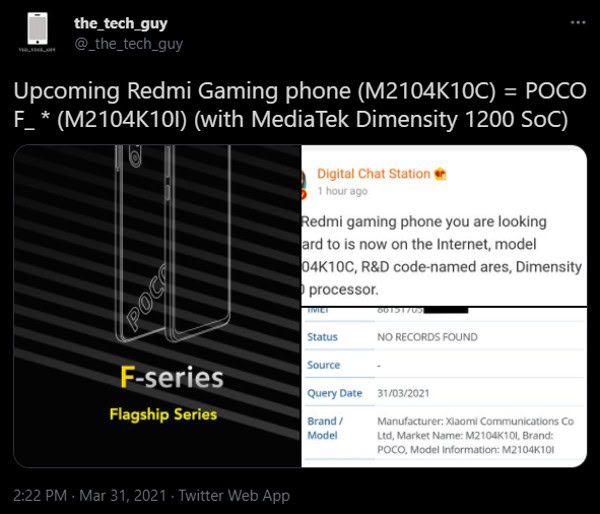
Prominent leaker Digital Chat Station reported on Weibo yesterday that the Redmi gaming phone has the model number M2104K10C and is code-named Ares. But Twitter tipster The_Tech_Guy spotted a Poco-branded phone on an Indian IMEI database, complete with the model number M2104K10I.

The Tech Guy Redmi gaming phone poco

Xiaomi usually tweaks the last letter of a phone’s model number to denote a regional variant. So Chinese variants end with ‘C’, Indian models end with ‘I’, and global variants end with ‘G.’ This therefore suggests the Redmi gaming phone is indeed on the way to India, and it looks like it’s receiving the rebranding treatment.

It wouldn’t be the only Dimensity 1200 phone set to make its way to India though. The Realme GT Neo was announced in China earlier this week, but the device has reportedly slipped through India’s BIS regulatory body website.

In any event, the Dimensity 1200 offers flagship-level CPU performance thanks to four Cortex-A78 cores and four Cortex-A55 cores (no Cortex-X1 here, unfortunately). You’re also looking at the same Mali-G77 MP9 GPU seen in last year’s Dimensity 1000 series, as well as software-based ray-tracing support and refresh rates up to 168Hz.

MediaTek’s flagship SoCs have historically had a reputation for being cheaper than Qualcomm’s flagship chipsets. So it stands to reason that the Redmi gaming phone will be cheaper than Snapdragon-toting gaming phones. But Qualcomm’s flagship chips usually enjoy superior graphical performance and better support in emulators, so you might want to wait for reviews of the Redmi/Poco gaming phone before you ready your wallet.

What do you want to see from a Redmi gaming phone though? Let us know by taking the poll further up the page.


from Android Authority https://ift.tt/3dmDKMs