Sunday, 1 August 2021

Samsung Galaxy A11 review: A solid starter smartphone https://ift.tt/3je3oG6

You don’t have to break the bank for your first-ever smartphone. In fact, Samsung will offer you a solid blend of One UI, a headphone jack, and three rear cameras for less than $200. It sounds pretty good in practice, but let’s see what reality holds. This is our Samsung Galaxy A11 review.

See also: The best Samsung phones

$169 .99
Samsung Galaxy A11
Buy it Now
Samsung Galaxy A11 Buy it Now
$169 .99

What you need to know about the Samsung Galaxy A11

The Samsung Galaxy A11 lying face up on cardboard showing the default launcher on the screen.

Credit: Luke Pollack / Android Authority
  • Samsung Galaxy A11 (2GB RAM, 32GB): $169 / £139 / €160
  • Samsung Galaxy A11 (3GB RAM, 32GB): $179 / £235

The Galaxy A11 is one of Samsung’s most affordable smartphones, and it replaced the Galaxy A10E in early 2020. It comes with limited storage options — 32GB or 64GB — but you can choose from a few classic Samsung finishes, including blue, white, and black. The Samsung Galaxy A11 we tested arrived running Android 10 with One UI 2.1 on top. It has since received Samsung’s One UI 3.1 update in May 2021 and is now running Android 11.

As for the internals, Samsung tapped Qualcomm’s Snapdragon 450 processor, up to 3GB of RAM, and a healthy 4,000mAh battery. Samsung’s 6.4-inch HD Plus display ties it all together, and there’s even a headphone jack at the top of the phone. You also get a bottom-firing mono speaker for a little more audio flexibility.

The Samsung Galaxy A11 comes with a USB-C charger in the box, as well as a white pair of wired earbuds and a SIM ejector tool. Not bad overall for a phone at this price.

Samsung’s Galaxy A11 fits into a similar price range as the OnePlus Nord N100 and Motorola Moto E. If you’re dead-set on Samsung, the newer Galaxy A12 is also worth a look. Although the Galaxy A12 may pack the latest tech, it’s not as widely available as its older sibling quite yet.

What’s good?
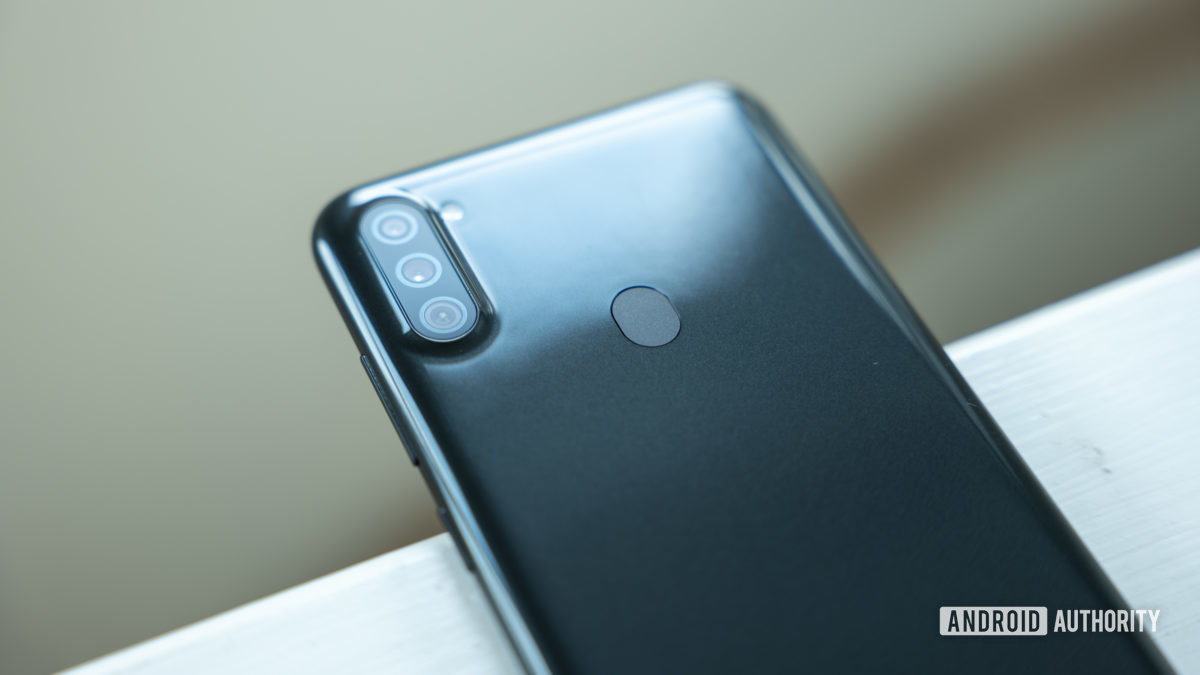
The Samsung Galaxy A11 back cameras sitting on white windowsill

Credit: Luke Pollack / Android Authority

It’s tough to go wrong with Samsung’s One UI interface. In fact, the ability to do just about anything with one hand makes the Galaxy A11’s 6.4-inch display feel much more comfortable. There’s little to no bloatware on the unlocked Samsung Galaxy A11, but carrier-based devices may have some unwanted extras.

My Samsung Galaxy A11 also arrived running on Android 10 but received its Android 11 update in mid-May. It wasn’t Samsung’s fastest update ever, but the latest version of Android with One UI 3.0 on top certainly provides a bit of a boost. The volume controls are larger than ever, and the notifications clean up nicely.

Samsung went the extra mile with security options on the Galaxy A11, offering both a rear-mounted fingerprint reader and face unlock options, though the latter is software-based, so a little less secure. While public mask mandates are still in place, it’s nice to have unlocking options when I’m at home. Should either of those methods fail, you can always turn to a PIN unlock or pattern method instead.

See also: The best phones with a headphone jack

The Galaxy A11 keeps a classic feature that most Samsung flagships have ditched: the headphone jack. We couldn’t get through this section without showing it at least a little bit of love. You get a pair of wired earbuds packaged with the phone, too. They’re not the most comfortable for long listening sessions, but they’re a good beater pair that you won’t have to worry about.

Of course, if you’re considering a budget-friendly smartphone, you might be worried about a slightly weaker camera. I certainly had my own reservations, but the primary 13MP shooter left me impressed. Granted, you can still take some stinkers, but it should work well for you, given the right lighting. You can check out some examples later in this review.

The final boon for the Samsung Galaxy A11 is its battery life. The 4,000mAh cell is plenty large, especially considering that you don’t have 5G drain to worry about. I found the phone regularly lasting a full day or more bouncing between apps and videos.

What’s not so good?
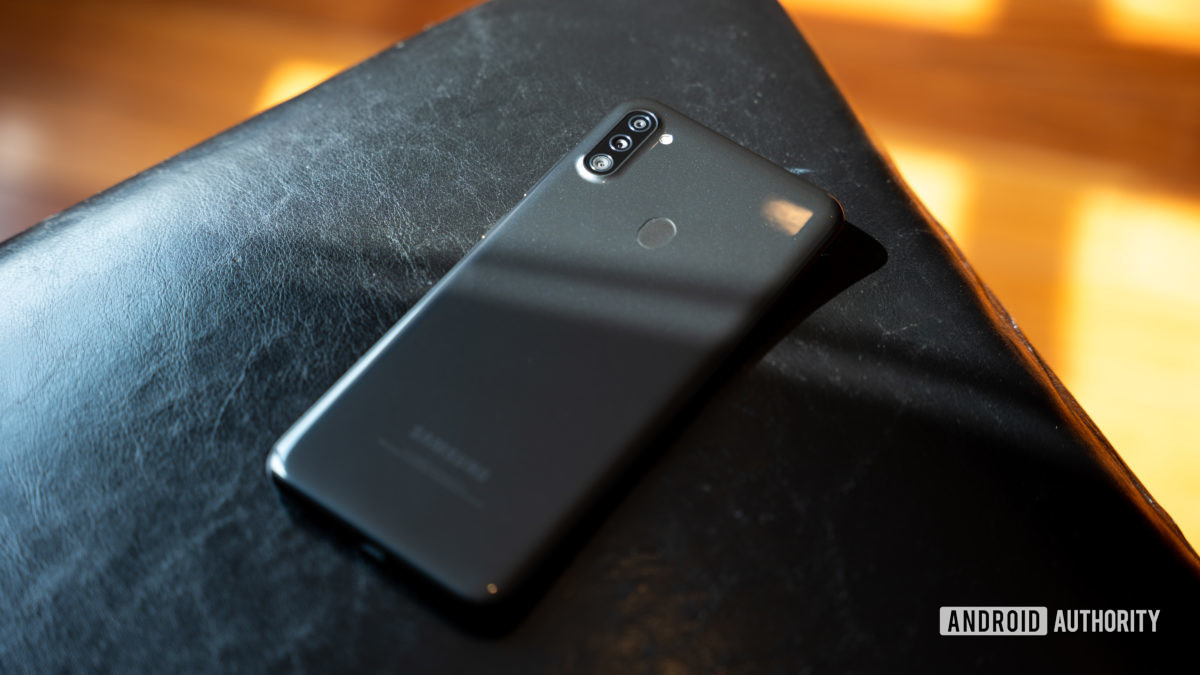
The Samsung Galaxy A11 back lying on black chair

Credit: Luke Pollack / Android Authority

Even though the main 13MP lens impressed, the others did not. Whether it was a selfie or an ultra-wide shot, there was always something missing. I found that the 5MP ultra-wide samples often came back grainy, and any zoom (digital only) resulted in an immediate loss of detail and fidelity. On the selfie side, images often seemed as though I had fingerprints on the camera — even if I had just wiped it down. I occasionally managed a decent selfie, though the background noise is far more noticeable indoors, and there’s a lot of skin-smoothing going on.

I also found it hard to get past the glossy plastic construction. Not because it was plastic, but rather because the Galaxy A11 proved to be a magnet for fingerprints and dirt. I prefer a clean phone, so I found myself constantly itching to wipe down the back panel. The plastic doesn’t feel too bad in hand, but a matte finish could have gone a long way.

The glossy plastic finish is a magnet for fingerprints and dirt.

Unfortunately, Samsung stuffed the Galaxy A11 with Qualcomm’s Snapdragon 450 processor. While this would have been just fine in years past, the Snapdragon 450 launched back in 2017 and is starting to show its age. I noticed occasional lag if I tried to jump between apps in a hurry, and downloading games like Pokémon Go took longer than expected. I’m not sure whether this is due to the processor itself or the 2GB of RAM, but Samsung probably could have remedied it with some boosted specs.

While I noted the Galaxy A11’s solid battery life above, the charging performance is less than stellar. You can get 15W speeds with the included charger, but you’ll have to be ready to sit by an outlet for quite a while — easily an hour and a half if you’re starting from zero. There’s no wireless charging option, but that’s not a surprise given the price.

Samsung Galaxy A11 camera samples

A Samsung Galaxy A11 image taken with the 5MP ultra-wide camera A Samsung Galaxy A11 image taken with the 13MP main camera A Samsung Galaxy A11 image taken with the 5MP ultra-wide camera

A Samsung Galaxy A11 image taken with the 13MP main camera

Samsung Galaxy A11 specs

  Samsung Galaxy A11
Display 6.4 inches
720 x 1560 (19.5:9)
Processor Qualcomm Snapdragon 450
RAM 2GB / 3GB
Storage 32GB / 64GB eMMC 5.1
Cameras Rear triple camera:
13MP wide (f/1.8)
5MP ultrawide (f/2.2)
2MP depth (f/2.4)

Front:
8MP (f/2.0)
Battery 4,000mAh
15W Fast Charging
No wireless charging
IP Rating None
Software Shipped with Android 10
Updated to Android 11, One UI 3.1
Dimensions 6.35 x 3.00 x 0.31 inches
(161.4 x 76.3 x 8mm)
6.24 oz (177 g)
Colors Black
White
Blue
Red
Security Rear-mounted fingerprint scanner
Face unlock

Samsung Galaxy A11 review: Should I buy it?

The Samsung Galaxy A11 standing on countertop showing the default launcher on the screen.

Credit: Luke Pollack / Android Authority

The Samsung Galaxy A11 is a textbook budget-friendly phone. It packs modest specs and cuts some corners, but it can still surprise you. It scores points on battery life, a headphone jack, and the main 13MP camera. Yet the Galaxy A11 misses with an aging processor, weak support cameras, and a fingerprint-hungry finish.

See also: The best budget phones you can currently buy

Samsung’s Galaxy A11 falls in line with the OnePlus Nord N100 and Motorola Moto E in terms of pricing, and it’s best suited for someone with little smartphone experience. You can also check out the successor in Samsung’s Galaxy A12. Still, the older device is more popular among MVNOs, so you can probably find an affordable plan to match your affordable phone.

Samsung Galaxy A11
Samsung's entry-level Galaxy A11 cuts a few corners in terms of cameras and processing power, but it has the power to surprise at a rock-bottom price.


from Android Authority https://ift.tt/3lfbgdc

Watch a young Kurt Russell become a teen cyborg on Disney Plus https://ift.tt/3zYETUi

The Computer Wore Tennis Shoes Disney Plus Disney Classic
Credit: Disney

From the Vault: As the streaming space keeps growing, massive studio catalogues are becoming more and more available. These include lost and forgotten gems, so-bad-it’s-good duds, and just plain weird pieces of film history. And you probably won’t find them by waiting for streamers to put them in front of you. In From the Vault, Android Authority aims to rescue these titles from the algorithm graveyard and help you get more out of your streaming subscriptions.


When Disney Plus launched in 2019, the big-ticket items were new Star Wars content like The Mandalorian and Disney classics like The Little Mermaid and Beauty and the Beast. But digging through the “Throwbacks” and “Nostalgic Movies” sections of the Disney streamer is a great way to find buried gold. Gold like The Computer Wore Tennis Shoes.

This 1969 film offers a campy, retro look at teen life at the dawn of the computer age. And it’s an absolute pleasure to watch.

It’s hard not to get hooked in immediately by the opening title animation, a stop-motion kaleidoscope of faux computer graphics set to a very of-its-time pop song written for the film.

The film spawned two sequels — Now You See Him, Now You Don’t and The Strongest Man in the World — and took place at the fictional Medfield College. Medfield had already appeared as the setting of the Disney film The Absentminded Professor and its sequel Son of Flubber earlier in the 60s.

Director Robert Butler had credits including Batman, The Twilight Zone, The Fugitive, Hogan’s Heroes, I Spy, and Mission: Impossible under his belt. He brings the sense of whimsy, adventure, and energy typical of those shows to The Computer Wore Tennis Shoes for a family film worth revisiting.

Disney Plus Annual Subscription

What is The Computer Wore Tennis Shoes about?

In The Computer Wore Tennis Shoes, Dexter Reilly (Kurt Russell) is a below-average student at Medfield College. Despite a fear of flunking out, Dexter and his friends have a real affinity for the school. And particularly their favorite teacher, Professor Quigley.

Knowing that Quigley wants the school to buy a computer, Dexter and his friends want to help. They set out to convince a wealthy local businessman (played by the always-fabulous Cesar Romero) to pony up the money. But while picking up a part for the new tech, Dexter accidentally jacks into the computer. He absorbs its wealth of data and programming to become a walking, talking computer.

Now a boy genius, Dexter gets wrapped up in a gambling scheme with criminals. (The generous businessman’s fortunes may have come by less than legal means.) Dexter and his friends have to get out of trouble and restore order at Medfield before the crooks can stop them.

The risks and rewards of technology

Credit: Disney

We can’t really talk about The Computer Wore Tennis Shoes without addressing the very dated elephant in the room. The entire plot revolves around a school purchasing a single computer for $10,000.

One computer.

A single, room-sized computer.

For $10,000.

Even setting aside that the price tag would be closer to $75,000 today adjusted for inflation, it’s hard not to enjoy such a premise for its quaintness.

And the film handles technology well, from a thematic stance. Professor Quigley wants to prepare the school’s kids for the future. He firmly believes the school has a responsibility to spend the cash.

And when Dexter first starts using his new gifts, he has to learn that raw knowledge isn’t everything. The people in his life are what matters, and he can’t just ditch them for superficial success “online.”

The Computer Wore Tennis Shoes actually has lots to say about our 21st-century problems.

At a time when school funding and the role of technology in our lives are hot-button issues, The Computer Wore Tennis Shoes actually feels like it speaks to a 21st-century audience on our own terms. At least a little.

Kurt Russel has had star power since day one

The Computer Wore Tennis Shoes Disney Plus Disney classic

Credit: Disney

One of the great pleasures of The Computer Wore Tennis Shoes is in watching its star. A fresh-faced Kurt Russel shines long before he would become a household name.

Russell has been acting for decades and was a recurring face on the Wonderful World of Disney in the 60s and 70s. But to fans of his grittier action hero persona of later years, The Computer Wore Tennis Shoes may come as a fun change of pace.

Russell carries the film well as the young Dexter. He balances the boys-will-be-boys rulebreaker, naive do-gooder, and over-confident prodigy elements of the character with skill.

He would have been around 17 when filming took place, and he was already displaying the wide artistic range that makes his later roles in films like Big Trouble in Little China, Escape from New York, The Thing, Breakdown, Grindhouse: Death Proof, and the Fast & Furious franchise such a joy to watch.

A new Disney classic?

Credit: Disney

Is The Computer Wore Tennis Shoes a forgotten and underappreciated Disney classic?

It certainly had its fans in 1969, with positive reviews in the Chicago Tribune and Los Angeles Times.

A 1969 review in Variety praised Butler’s graduation from the small screen to directing a theatrical feature and called the film “above average family entertainment.”

The New York Times had less favorable words for it, calling The Computer Wore Tennis Shoes “as exciting as porridge and as antiseptic and predictable as any homey, half-hour TV family show.” Ouch!

Mixed reviews aside, The Computer Wore Tennis Shoes has aged well and offers plenty for a family movie night. Its tight pacing, simple but clever premise, and sharp overall look all make it a solid find from the vault.

It may not dethrone The Lion King or Frozen in the hearts and minds of the nation’s children, but it’s certainly worth watching. Especially as part of your Disney Plus subscription.

$69 .99
Disney Plus Annual Subscription
Save $10 .00
Buy it Now
Disney Plus Annual Subscription Buy it Now
Save $10 .00 $69 .99


from Android Authority https://ift.tt/3fm13b3

AT&T’s 5G network is ready for Stadia, even if Stadia isn’t ready for mobile https://ift.tt/2WAjTEK

Google Stadia controller with phone mounted showing Mortal Kombat on the screen.

When Google first announced its cloud gaming service Stadia, we had a lot of high hopes. A “Netflix of games” that allows you to play on all your devices anywhere? Sign us right up! Of course, we quickly realized Stadia is not a “Netflix of games” and did not allow you to play on all your devices (at least not at first).

However, with the rollout of 5G networks across the United States, the possibility of playing anywhere is real. To test this out, AT&T reached out to us about trying Stadia on its 5G network. AT&T supplied me with a full mobile Stadia kit, including an official Stadia Premiere Edition (controller and Chromecast Ultra), a Stadia Pro subscription, a Google Pixel 4a 5G with an AT&T SIM card, and even a Power Support Claw to tie everything together.

I live in New Haven, CT, which has pretty robust AT&T 5G service. Can it handle streaming gameplay from Google’s servers thousands of miles away? The answer is complicated.

Stadia on 5G: Find a spot and stick to it

Google Stadia Claw holding a phone, with the controller in hand.

The first thing I did when I got the Stadia kit from AT&T was get everything set up. I connected all the gear to my home Wi-Fi network, activated my Stadia Pro subscription, and found a game to play (Chronos: From the Ashes). It only took me about 15 minutes before I was streaming Chronos to the phone and having a fine time playing it.

See also: The very best games on Google Stadia

Of course, the whole reason I got the kit was to test Stadia on 5G, not my home Wi-Fi network (which I humbly admit is wicked fast). I turned off Wi-Fi on the Pixel 4a 5G and saw the little 5G icon in the top right corner. I started up Chronos again and found the game to be basically unplayable. Check out the video below to see the dropped frames and stuttering:

Obviously, that result points to AT&T’s network just not being fast enough for Stadia, at least not at my home. Check out the speed test results below to see what I mean:

But hey, why would I ever be using 5G service at my house anyway? To give this a true test, I needed to head out into the world. I took a trip into downtown New Haven in the heart of Yale University and tried my luck out there. For the record, downtown is a five-minute drive from my house.

The speed tests I got downtown show a world of difference. Check them out here:

With those faster speeds, Chronos: From the Ashes played as well as it did on my home Wi-Fi. Framerates were smooth, controller lag was minimal, and everything looked crisp. I even sat in the passenger seat while my girlfriend drove us around, and had no issues playing the whole time.

Clearly, Stadia on 5G is totally possible, but you need to find an area with good service and stick with it.

It’s too bad about Stadia’s mobile issues, though

Google Stadia Founders Edition laid out on a cushion

In the previous section, I mention how I switched off Wi-Fi on the Pixel 4a 5G and played Stadia on 5G at my home. That isn’t the whole story, though. You see, the official Stadia controller itself connects to Wi-Fi to reduce input lag. That means if the controller and the screen (in this case, the Pixel 4a 5G) aren’t on a Wi-Fi network, things don’t work properly.

See also: Google Stadia vs GeForce Now

Now, there are a few ways around this. The first is pretty obvious, which is to ditch the Stadia controller for something else, such as an Xbox or PlayStation controller. Those connect to your phone with Bluetooth, which introduces some input lag but at least actually works. Confusingly, the Stadia controller does work with Bluetooth, just not when playing Stadia games. Seriously.

Another solution would be to use a cable and wire the phone and the Stadia controller together. This has the advantage of keeping input lag low, but the disadvantage of needing a cable.

Google doesn't make Stadia very easy to use on mobile networks.

A trickier option would be to use the phone as a hotspot and play on a different screen. A tablet, laptop, or even a second phone would make this possible.

The overarching problem here, though, is that none of these solutions are obvious. The Stadia controller does not come with a USB-C to USB-C cable, so it’s not apparent you would need one to use it on mobile. Using a secondary controller — or worse, a secondary screen — seems to negate the whole purpose of using the Stadia controller at all.

Additionally, the Stadia app itself doesn’t help you out with this. When I tried to use the controller wirelessly on the AT&T network, it didn’t say, “Hey, you’ll need to grab a USB-C cable to do this.” It just flat-out failed and said I needed to connect it to Wi-Fi. That’s not at all helpful, Google.

Stadia works on 5G under specific conditions

Google Stadia controller on table close up shot.

Despite Stadia’s inherent mobile problems, this test shows that the service works well both on Wi-Fi and on 5G, assuming you are playing in a specific scenario:

  • You are in an area where 5G service is active and strong.
  • You are relatively stationary in that area.
  • The large amount of data Stadia consumes isn’t an issue for you (i.e. you have unlimited data). I saw Stadia consume about 100MB of mobile data per minute.

If you don’t meet all three of those criteria, you might have a bad time with Stadia on 5G.

Related: What is cloud gaming?

Unfortunately, the dream of being able to take a train and stream your game on a 5G network for the ride isn’t realistic at this point (that’s where a Steam Deck could come in handy). 5G just isn’t ubiquitous enough, so you’d face outages every few minutes. Hanging at the airport or a coffee shop and being able to game on 5G, though, is certainly possible — as long as you can afford unlimited 5G data.

Of course, until Google makes it simpler for official Stadia gear to work with mobile networks, it’s never going to be truly convenient.


from Android Authority https://ift.tt/3yjCFhQ

Will smartphones eventually ship with nothing else in the box? https://ift.tt/2Glfmhs

Oppo Reno 4 Pro 5G rear shot on a desk next to the charger and box — this could change if Oppo decides to drop power adapters.
Credit: Ryan-Thomas Shaw / Android Authority
Opinion post by
Roger Fingas

Apple made headlines in October 2020 when it decided to drop power adapters not just from the iPhone 12 lineup, but from all iPhones going forward. Samsung has joined suit with flagships like the S21, ensuring that the decision will have a wide impact. Could it be that these policies will quickly become an industry standard, forcing every new smartphone owner to buy basic accessories on top of increasingly expensive hardware?

First, let’s back up a bit and talk about motivations. During the iPhone 12 reveal Apple made a big deal about reduced environmental impact, which is undeniable. Electronics of any kind require minerals and plastics, which strips the Earth of finite resources, never mind the pollution generated by the supply chain. Fewer accessories allows for less packaging, which saves on resources like trees and makes shipping more environmentally efficient. This is offset to an extent by the extra material and supply chains needed for third-party accessories, but as long as people don’t ramp up those purchases, the logic checks out.

The reality however is that Apple and Samsung aren’t offering free adapters (or earbuds for that matter) to shoppers who need them. They’re charging full price, and not even discounting their phones to compensate. It’s obvious that profit margins are a major incentive for dropping bundled accessories, if not the primary motive.

Where are Apple and Samsung headed?

Yootech F500 Wireless Charger with iphone and accoutrements.

Credit: Eric Zeman / Android Authority

The decision to drop power adapters means the only thing included with Apple and Samsung phones at the moment is a connector cable. In the case of Apple, of course, it’s a Lightning cable, limiting usefulness further. Apple has resisted pressure to switch iPhones over to USB-C — which is perhaps the strongest argument against its environmental position. Proprietary ports mean customers have to buy separate, proprietary accessories.

Glancing a few years down the road, the speculation is that Apple will remove ports entirely. It showed the “courage” to drop the 3.5mm headphone jack with 2016’s iPhone 7, and has since made wireless charging standard, even if top-up times lag behind many Android devices. The Lightning port continues to serve several functions — CarPlay, accessories, faster charging, and iTunes sync — but it’s easy to imagine a future in which Apple claims wireless is all anyone needs. It would allow the company to remove all bundled accessories, slash component costs, and clean up the iPhone’s internal design space.

The best wall chargers: A buyer’s guide

Samsung has been imitating Apple for well over a decade, so it probably won’t be far behind if the iPhone does go portless. It’s unlikely to jump in with both feet, however. Much of Samsung’s mobile revenue comes from markets where people are inclined towards budget models and can’t necessarily afford to load up on wireless accessories. Expect premium phones in the Note and Galaxy S lines to go first.

Even Apple will probably try some sort of stepped approach, at least keeping an older Lightning-equipped iPhone around while newer models make the leap. It could theoretically reserve portless tech for Pro phones, but it might be easier to encourage adoption if every new model is onboard.

What about the rest of the smartphone market?

OnePlus Nord 2 showing the screen — bucking the trend to drop power adapters from the box.

Credit: Dhruv Bhutani / Android Authority

Because of budget-conscious demographics, it’s going to be difficult to sell the masses on phones without some bundled accessories, much less portless devices. The latter may require technologies like 5G and high-speed Qi charging to feel seamless — and those haven’t become universal in Europe or North America, forget the rest of the world.

Cost savings and the influence of Apple and Samsung are hard to resist, so the long-term trend is towards dropping accessories.

Even if Apple and Samsung lead the way, it will probably be years before the rest of the industry follows, and a total transition isn’t guaranteed. Bundles can be a competitive advantage, as evidenced by the OnePlus Nord 2, which bucks the trend to drop power adapters and other accessories by shipping not just with a USB-C cable and charger, but a case and screen protector. In France, it even comes with wired earbuds. Xiaomi doesn’t include a charger in China, but it does offer one at no extra cost and bundles the accessory with global versions of the Mi 11.

Cost savings and the influence of Apple and Samsung are hard to resist, so the long-term trend is towards dropping accessories. It seems safe to say though that by the time they all vanish, it won’t matter as much. Consumer reaction is going to slow the process, and hopefully wireless technologies will become better and more ubiquitous by the time the last cable is removed from a smartphone box.


from Android Authority https://ift.tt/3xm7ocx

It’s high time that all iPhones had zoom cameras https://ift.tt/2Vq8yGZ

iPhone 12 back showing the camera module.
Credit: David Imel / Android Authority
Opinion post by
Roger Fingas

The rules of photo composition are hardly set in stone, but two related ones are almost always applicable: fill the frame, and eliminate dead space. If your subject is a car, say, that car should be dominant in the frame unless its surroundings serve a purpose. Any featureless parts of the frame are “dead” unless they’re there by design. Why, then, does Apple seem to treat zoom as a second-class feature on its iPhone and iPad cameras, at the same time as Samsung is making it a priority?

Consider the iPhone 12 lineup. Both the standard phone and the Mini are equipped with twin lenses, but these are wide- and ultra-wide components. Their focal lengths are equivalent to 26mm and 13mm on a full-sized DSLR camera, which puts shooters pretty far away from the action. You have to spring for a Pro or Pro Max to add a telephoto lens, and even those iPhones top out at 2x and 2.5x optical zoom — equivalent to 52mm and 65mm, both of which are only mid-range in the DSLR world. We’re discounting Apple’s 10x “digital” zoom, which past the 2/2.5x mark simply blows up the image, making things increasingly pixelated and blurry.

This contrasts with Samsung’s Galaxy S21 series, which offers 3x “hybrid optic” (optical/digital) zoom at a minimum. That’s not much better than an iPhone 12 Pro, but you can get up to 10x optical zoom on the Galaxy S21 Ultra — that’s equivalent to a 240mm full-size lens, better even than what photojournalists typically use. Notably, all of Samsung’s Galaxy S21 phones also offer the full trifecta of cameras: wide, ultra-wide, and zoom. Heck, even the mega-affordable Galaxy S20 FE managed it.

If Samsung can offer the trifecta with all of its flagships, iPhone buyers shouldn't have to pay extra for zoom.

A few other Android phone makers are on the same track. Flagship devices like the OnePlus 9 Pro, for example, often include a 3.3x telephoto paired with an ultra-wide and a wide main shooter. However, a lot of more affordable Android phones share the iPhone 12’s wide/ultra-wide combo. This is especially prevalent in the budget sphere (often joined by a superfluous third shooter like a macro camera), but it’s also the case with affordable flagships like the Google Pixel 5, the Xiaomi Mi 11, and the pro-less OnePlus 9. To be fair, it’s not a useless arrangement. Ultra-wide lenses excel at capturing spaces and large groups, which can be handy for architecture, landscapes, and events like parties. Outside of these use cases, however, they tend to make good composition tricky, and can introduce perspective distortion towards the edges of the frame. Speaking from experience, this is why pros rarely shoot portraits with an ultra-wide.

See also: The complete guide to ultra-wide camera phones

Telephotos have their own limitations, yet they’re almost always more useful — not just for composition, but because people typically struggle to get closer to a subject rather than further away. If you’re shooting a concert, crowds are probably separating you from the stage. If you’re at a wedding, you’re only allowed so close to the altar. A telephoto lens can mean the difference between getting a shot or ending up with nothing worthwhile. These lenses should be standard equipment on iPhones, especially with Samsung breathing down Apple’s neck. More importantly, though, consumers shouldn’t have to choose.

Why Apple is short on zoom, and when that could be fixed

iPhone 12 Pro Max showing the camera module.

Credit: David Imel / Android Authority

There are a few reasons Apple may be pursuing its current strategy. Consumer popularity can’t be ruled out — while a recent Android Authority poll found that the majority of people prefer telephotos, 45.81% of readers chose ultra-wides. Depending on who Apple is listening to, its market research might support going wider.

The company is also obsessed with thin and sleek designs, sometimes at the expense of practicality. Modern iPhones already have a camera bump, and going beyond 2.5X optical zoom would probably demand a bigger sensor and periscoping lens technology. That, in turn, might force Apple to enlarge the bump, or commit the worst of all sins (in Apple’s eyes) by making the chassis noticeably thicker.

Related: Samsung Galaxy S21 Ultra vs Apple iPhone 12 Pro Max

Its leading motivation, though, is probably minimizing component costs. Periscoping lenses are currently more expensive, and even designing a thicker chassis might be seen as an unnecessary cost increase if shoppers are tolerant of the status quo. So it makes sense to choose an ultra-wide as the one additional lens on iPads and the vanilla iPhones.

Working on that assumption, Apple is unlikely to add telephotos to its standard iPhones anytime soon. It’s even rumored that autofocus is coming to the ultra-wides on the iPhone 13 Pro and Pro Max before anything more affordable. If telephotos do eventually leap to entry-level iPhones, it will probably be thanks to a combination of market pressure and falling parts prices.

If we’re critical of Apple here it’s not out of spite. The company has consistently had some of the best smartphone cameras on the market for about a decade. It’s simply frustrating when a company handicaps its own technology, or asks customers to pay extra for something that should be on every device. A triple-lens setup should be the norm for phones of this caliber. If Samsung can do it, there’s no reason Apple can’t too.

Up next: The best triple camera phones — what are your options?


from Android Authority https://ift.tt/3C1HTkz

Weekly Authority: Edition #153 https://ift.tt/38RVhdh

⚡ Welcome back The Weekly Authority, the Android Authority newsletter that breaks down the top Android and tech news from the week. The 153rd edition, right here!

🚀 Tristan Rayner with you and this week's news is that, I think, I think I got a PS5! Finally! I mean, I paid for it, Sony seemingly has my money, it just has to get here now while I stare out the window waiting...

Popular news this week

Motorola Edge 20 Pro official

  • Motorola Edge 20 series: Moto's back with the Edge 20 series, with a Pro, a Lite, and a middle-tier edition too. The Pro looks beefy: a 6.7-inch 144Hz OLED, a Snapdragon 870, triple camera including 5x periscope lens, and a 4,500mAh battery. Not bad for £650/€700. The middle or standard version cuts a few high-end features to drop back to a £430/€500 buy, but still looks very good, while the Lite edition for £300/€350 drops back to a Dimensity 720 chipset, but keeps the Edge 20 series spirit with its other features.
  • Motorola's decision to only guarantee two years of Android OS upgrades and at least two years of bi-monthly security updates wasn't well received.
  • Huawei P50 series: Once a major release where Huawei would fly in the world's media, the P50 series launched in China with limited details about when others might see it.
  • The star of the P50 Pro is the camera, as usual with a quad-lens system: 50MP main, a 13MP ultra-wide, a 64MP telephoto, and a 40MP monochrome sensor, with high-end color accuracy. DxOMark said it was the new number one on its rankings, performing well in nearly all conditions, though images in the phone preview versus final captures were a little off, "especially in high-contrast light conditions," DxO wrote.
  • Surface Duo 2: A leak showed a second-generation Microsoft Surface Duo, with some confirmation out of Windows Central that the concept is legit, even if the leaks looked a little raw.
  • The main thing on display was a rear camera module, something badly needed after the original Surface Duo had a bad camera for a $1,399 price tag. Possibly more important is how hard Microsoft has re-worked the software experience, given that wasn't great either.
  • Nothing Ear 1 reviews: The good news for Carl Pei's venture is that his first product, the Nothing Ear 1, is good! An array of reviews went live, including at our sister site SoundGuys, which said: "These are some of the lightest and most comfortable earbuds around. The Nothing Ear 1 also sounds pretty good, has active noise cancellation, and has a great microphone."
  • A 7.4/10 is pretty solid at the $99 mark.
  • Google bans sugar daddy apps: Google stepped in over some debate about dating apps, or more specifically, less mainstream dating apps that connect people of different wealth levels, for potential sugar daddy purposes. In a statement to Android Police, Google said: "We have updated our inappropriate content policy to prohibit apps that facilitate sexual acts in exchange for compensation following feedback we received from NGOs, governments, and other user advocacy groups concerned with user safety. This aligns our policies with other Google policies and industry norms." Apple already did so back in 2018, after the FOSTA-SESTA act.
  • PlayStation 5: Sony said it had sold 10M units of its latest console (The Verge), meaning it's sold faster than any other PlayStation to date, despite the lack of availability. Even my colleagues at Android Authority have struggled to buy one despite being Very Online People! In any case, Sony said "We still have a lot of work ahead of us as demand for PS5 continues to outstrip supply." Blame the pandemic, blame the chip shortage! 

Reviews

Close up of smartphone camera lens

Features

Tech Calendar

  • July 31-August 5: Black Hat USA
  • August 5: Motorola event in China
  • August 11: Samsung Unpacked event

Tech Tweet of the Week

As always, thanks for reading!

Tristan Rayner, Senior Editor.


from Android Authority https://ift.tt/3xgnkgK

10 best NEW Android games from July 2021 https://ift.tt/eA8V8J

Android gaming is getting bigger and better every month it seems and there is always a slew of new titles coming to Google Play. Whether you’re a casual gamer or you want something with a bit more meat on its bones, there’s usually a game coming out to suit everyone’s taste. Some months are better than others, but there is usually at least one great new game on mobile every month. Let’s take a look at the best new Android games from the last month! You can also check out our picks for the best new Android games for 2020 in our video here!

The best NEW Android games from July 2021:


Alchemy Stars: Aurora Blast

Price: Free to play

Alchemy Stars: Aurora Blast is a strategy RPG with some gacha elements. You know how gachas work. You summon characters, upgrade them, and use them to fight off bad guys. The game uses what it calls a line combat style. It’s a riff on strategy RPG combat mechanics that is actually pretty fun. The game also includes voice-overs, above-average artwork, and plenty of things for players to do. The biggest complaint is the energy system that prevents you from playing a ton all at once. Otherwise, it’s a competent gacha without a ton of issues.

Get it on Google Play


Aotu World

Price: Free to play

Aotu World is a rather unique game. It’s a mobile RPG with gacha mechanics along with some rhythm game mechanics. The battle system is grid-based like most strategy RPGs. However, each square determines the action your character takes. The game also includes puzzle stages where you solve puzzles to progress. There is also an online PvP mode if you’re interested. The game launched with a crossover event that features the very popular Hatsune Miku as a way to encourage players to join and play. The event lasts until August 10th, 2021. There is a lot of stuff in this game to do, even if the mechanics occasionally take a second to get right. The only big complaint is the PvP balancing. Hopefully the developers fix that up.

Get it on Google Play


Claw Stars

Price: Free to play

Claw Stars is an arcade game. It uses similar mechanics to those old claw machine games you see at arcades. Players play the role of super smart hampsters that use a claw machine to save cute little animals. It basically plays out as you would expect from there. You get various prizes and upgrades as you play. You use the collectibles to build planets for your animals. There are also some social features that let you play with friends. This isn’t a super deep game, but the arcade nature makes it great for shorter play sessions.

Get it on Google Play


Escape Lab

Price: Free / $0.99

Escape Lab is a thriller escape room game with a co-op spin. You and a friend play together and solve puzzles to make it through the game. The game takes place in a creepy lab that you must escape before you become the next victim. There is a need for constant communication so you and your friend may need Discord, a phone call, or some other voice call in order to play if you’re not in the same room. The mechanics are otherwise pretty simple. You find clues, solve puzzles, open doors, and keep moving. The developers say it takes around 60-90 minutes to finish, which is perfectly acceptable for its bargain price tag.

Get it on Google Play


Mitrasphere

Price: Free to play

Mitrasphere is the latest game from Crunchyroll. Yes, the streaming service. It boasts itself as a co-op RPG where you and friends play together to defeat bad guys. The game leans heavily on the social parts of the game and actively encourages you to make private chat rooms and hang out with other players. The combat style is 2D and side-scrolling with abilities to use with cooldowns. It’s not a difficult game to play. There is no energy limit, but drop rates on upgrade materials is low so you still have to grind for quite a long time. It has some bugs because it is still new, but the developers are working on it. It’s free to play, so keep that in mind, but it’s otherwise pretty good.

Get it on Google Play


My Talking Angela 2

Price: Free to play

My Talking Angela 2 is the latest game in Outfit7’s long-running My Talking Tom series. This one expands on the previous game with better graphics and plenty of things to do. Players hang out with Angela, dress her up in clothes, help her learn how to do dance, and do other things. The game has mini-games to keep the player engaged and plenty of collectibles to collect. It increases the interactiveness of the first game by a mile so fans of the first game should enjoy this one even more. It has some early bugs, but nothing too serious. This game is also kid-friendly.

Get it on Google Play


Rogue Land

Price: Free to play

Rogue Land is the latest game from Huuuge Games. It’s an action-adventure game where players defeat bad guys, explore the world, and find stuff. The combat system is pretty simple. You select an attack and your character performs it. There is the main story you can play through along with side quests. The game also has plenty of gear and loot to collect to upgrade your character. The gear also has special abilities to help you out in battle. It’s actually a rather well-done and F2P-friendly game for its genre, which is especially surprising considering the developer traditionally makes their bones on casino and slots games.

Get it on Google Play


Shining Nikki

Price: Free to play

Shining Nikki is the long-awaited sequel to the popular idol game Love Nikki. The developers spent a long time on this one and it definitely shows. The graphics are some of the best of any game we’ve seen this year. It’s primarily a fashion game where you dress up Nikki in all kinds of outfits and then take her on photo shoots for things like magazines. The storyline is presented in the same style as visual novels, where you move from scene to scene as the story progresses. It’s definitely not for everybody, but Love Nikki was a pretty big game in the fashion genre and we expect this one to be as well.

Get it on Google Play


Trials of Mana

Price: $23.99

Trials of Mana is the latest console port from Square Enix. The original game sold over a million copies on the Super Famicom back in its day. Square Enix re-released the game on several platforms, the most recent of which is Android. It’s the sequel to Secret of Mana. Trials of Mana is an action RPG with a fairly typical story. You, the hero, work on unlocking the power of the Mana Stones to save the world. As per the norm with Square Enix, the port is very well done with usable mobile controls and good graphics. They didn’t mess with the story at all so it’s a faithful recreation of the original. The mobile-specific features include cloud saving, some automatic controls to make things easier, and a couple of items that give you more experience and money until you hit level 17. It’s expensive. However, Square Enix ports tend to drop in price over time so you just have to wait it out for a sale if you don’t want to pay full price.

Get it on Google Play


The Witcher: Monster Hunter

Price: Free to play

The Witcher: Monster Hunter is an AR game similar to Pokemon Go or Harry Potter Wizards Unite. Players roam the real world and fight monsters. You improve your skills, gear, and tactics over time to take on more and more powerful monsters. The game also has some neat features, like using the time of day to determine what monsters you find. Unlike most AR games, this one actually goes for telling a story. In addition, the progression is quite good, materials are relatively easy to get, and the grind isn’t too intimidating. It’s a nice addition to the AR genre overall.

Get it on Google Play


If we missed any great new Android games, tell us about them in the comments! You can also click here to check out our latest Android apps and games lists!
Thank you for reading! Try these too:


from Android Authority https://ift.tt/3vBC1uB