With the transition to new networking technology, some familiar scare stories are reemerging. You might even have seen a few in the comments here. “5G will give you cancer,” “mmWave technology leads to brain tumors,” and “smartphones are microwaving our bodies,” or so the stories go.
It’s all hogwash.
Many of the persistent myths about cell tower radiation still hang over the industry from as far back as the 2G days. Many are wrongly concerned about the dangers even faster 5G technologies. Let’s examine the leading studies and some of these persistent rumors surrounding apparent 5G dangers to put your mind at ease about the safety of mobile technology.
Read next: Don’t believe the carriers, the 5G revolution is still years away (SA vs NSA)
Understanding radiation
Radiation probably makes you think about waste hazards and nuclear bombs. While that’s fair, there are plenty of very safe forms of radiation. In fact, we’re constantly bathing in background radiation, like cosmic rays from the sun.
There’s a major difference between safe radiation and the bad type associated with places like Chernobyl or X-ray machines. This is the difference between ionizing and non-ionizing radiation. Ionizing radiation appears at wavelengths above ultraviolet light, aka X-rays and gamma rays. These can damage your DNA by knocking electrons out of the base molecules, leading to tumors and cancer.
 Wikipedia
Lower frequency radio waves, like what’s used for LTE mobile networks, are non-ionizing — they can’t cause the same type of damage. Certain non-ionizing wavelengths can still be bad for you, as they produce heat at extremely high power level. Your microwave can warm up some nasty TV dinners just fine, but it requires more than a thousand watts of power to do so.
A UV tanning booth is much more dangerous than LTE and WiFi signals.
The FCC’s safe limit for mobile phones is a specific absorption rate (SAR) of 1.6 watts per kg (1.6 W/kg) of mass, nowhere near enough to warm up your body. Smartphones marketed in the U.S. must demonstrate compliance with this limit before they go on sale. ICNIRP guidelines used in Europe and most other countries set this limit at around 2.0 W/kg. These are the absolute legal limits of exposure. Most of the time the real-world values are significantly lower, especially when we put our phones down.
Can cellphones give me cancer?
Many studies have looked at if radio frequency electromagnetic radiation (RF EMR) can affect healthy people. A literature review in 2009, and the 2010 Interphone study both summarized the lack of findings on this topic quite well. In 2011, the World Health Organization (WHO) declared cellphones as a Class 2B carcinogen, meaning the technology may be linked to cancer. This does not instantly imply the level of exposure from commercial products is dangerous. Other Class 2B carcinogens include pickles, aloe vera leaf extract, and being a firefighter. The semantics are important here.
There have been no conclusive results indicating mobile technologies are eminently dangerous to humans, many astroturfers rely on how difficult it is to contextualize scientific results to make wild claims that go unchecked for a long time. In particular, they often cite one specific study as “proof” for their misinformation.
...you will never be exposed to the amount of RF EMR in this study.
The US National Toxicology Program (NTP)
In 2016, the U.S. National Toxicology Program (NTP) released draft findings of studies examining the effects of non-ionizing radiation on rats and mice. Several populations establish a control group, with males exposed to either CDMA or GSM cellphone radiation, and females exposed to GSM cellphone radiation. That’s 2G rather than modern 4G. Researchers applied the following exposure protocol to test the animals:
- Rats and mice were exposed to GSM or CDMA signals with whole-body exposures of zero to 15 W/kg (rats were given a lower dose).
- Exposure was initiated in utero.
- All exposures applied 7 days a week, for about 9 hours a day.
- A single, common group of unexposed rats or mice of each sex served as controls.
After two years, the study found several rats and mice exhibited tumors. However, these results mostly concerned full-body exposure rather than partial-body exposure for humans. There also weren’t adequate controls for exposure uniformity, making it tough to tell exactly how much exposure each rat actually received.
However, it is important to remember a few rats getting tumors when exposed to between two and four times the allowed limit (1.6W/kg) of RF EMR for cellphones does not constitute proof of anything. You will never be exposed to the amount of RF EMR used in this study. With the mice, they used ludicrously high power levels — up to 10W/kg for 2-year studies and 15W/kg for short-term ones. All test groups actually had higher survival rates than the control groups, illustrating how correlation is not causation.
Many foundations like the American Cancer Society report this study without taking a strong stance, but the FDA, National Cancer Institute, and FCC all note that the overwhelming evidence points to the safety of cellphones and technologies like Bluetooth and WiFi — even after considering the study’s results.
The Ramazzini Institute Study
Another popular report doing the rounds is the Ramazzini Institute Study of far-field radiation effects on rats. This very large study used radiation levels up to 60 times lower than the NTP study, within the range of what humans may experience. There have been several notable critiques of this research. While the total number of rats in the study was large, the number in each experimental group was still small.
5G: When will your smartphone get it?
5G is the next big thing in mobile communications. It promises faster speeds and lower latency, and opens the door to a whole new set of use cases for smartphones and well beyond. However, we're …
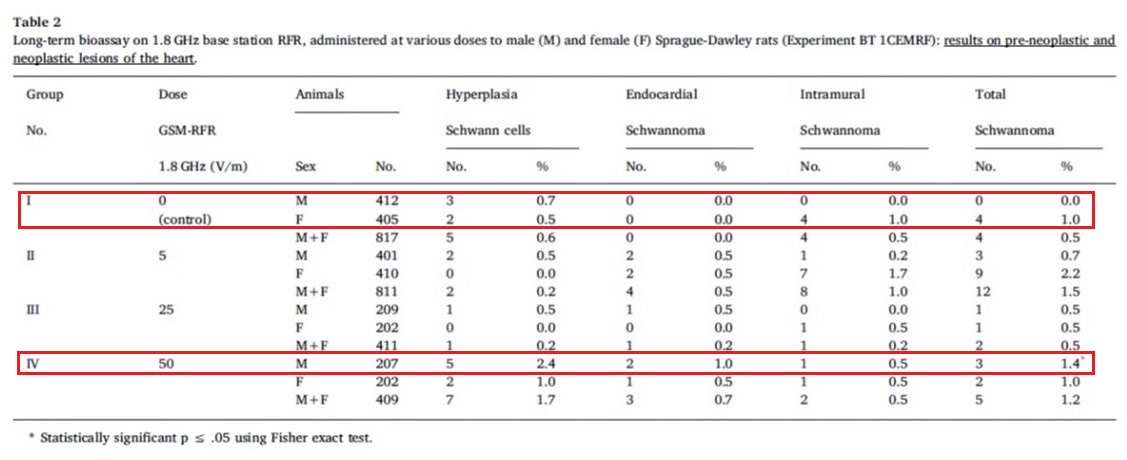
The only statistically significant finding of the report was an increase in the incidence of heart schwannomas (mostly benign tumors in the heart) observed in treated male rats at the highest dose (50 V/m) of radiation. The group estimated this to a SAR for comparison with the NTP study and FCC regulations which equates to roughly 0.1 W/kg, well within legal limits. Cue the scaremongering.
The research highlighted the male incident rate as statistically significant, noted at 1.4 percent, but not for the females. This is because the male control group exhibited a zero percent spontaneous schwannoma rate, compared to one percent in the female group. In other words, this data assumes male rats can’t develop schwannomas from any other sources, while females can. Accounting for some expected spontaneous schwannoma, the results quickly fall back into the statistically insignificant realm. The bottom line is the male-only data appears suspect, especially compared to the female results.
 BRHP
BRHP
Other lower tested power levels of 25V/m (0.03W/kg) and 5V/m (0.001W/kg) showed no such links. There are also further anomalies in the data. There was a higher schwannoma rate in female rats at the lowest exposure level. If the Ramazzini study’s data was totally correct, it also would’ve indicated the NTP study should have had much higher rates of tumor detection. At best, further investigation is required to rule out errors and explain these discrepancies.
Stephen Chanock, director at the Division of Cancer Epidemiology and Genetics at the National Cancer Institute, is skeptical about the results. The institute tracks brain tumors in the general population and has found nothing to report since work began in 2004. Furthermore, he sees no evidence from the Ramazzini study to suggest current safety limits for cell phone radiation are inadequate.
Dr Curry’s letter to Broward County Public Schools
In addition to poorly conducted studies, poor scientific theory is often used to whip up fear in wireless technologies too. One often-cited example is the warning letter sent to Broward County Public School by scientist Dr. Bill P. Curry in 2000. The claims in this letter were recently debunked in The New York Times and it serves as a showcase for bad science at work.
In the letter, Curry includes an infamous graph highlighting “Microwave Absorption in Brain Tissue (Grey Matter).” The graph proposes that the level of radiation received by human brains increases exponentially as the frequency of the wireless signal increases. This already seemed like bad news given network frequencies at the time and would be even more worrying with the adoption of 5G mmWave signals. To hammer the point home, Curry preys on the acute vulnerability of developing brains in children.
In late 2011, a Dr. David O. Carpenter used the graph in a lawsuit against Portland, Oregon public school in an attempt to force them to abandon their wireless computer networks. Dr. Carpenter continued to pursue this argument against various other network technologies, including 5G. The infamous graphic and line of reasoning have since been adopted by other alarmists looking to undermine confidence in wireless technologies.
However, there’s a problem – this graph is completely wrong.
Numerous experts on the biological effects of electromagnetic radiation confirm the opposite opinion. Higher frequency radio waves are safer, not more dangerous, until you reach extremely high frequencies such as X-rays. The reason for this is human skin offers a protective boundary that reflects high frequencies, protecting internal organs. Higher frequency radio waves are less likely to reach your brain than lower frequency waves. Curry’s graphic is simply not based on actual scientific evidence.
With 5G, the very high frequencies used by mmWave are reflected to such an extent that hand placement over your phone’s antenna can block the signal. The reflective properties of these waves are also what allows beamforming techniques to be used to bounce signals around corners. Simply put, 5G is not going to microwave your brain.
General cancer trends
Let’s quickly look at the historical statistics of cancer incidence rates. The coverage of cellphone networks and the number of bands dedicated to its use have expanded rapidly over the past decade, surrounding us with more wireless networks than ever before. If the radiation is dangerous, cancer rates should definitely be increasing.
SEER Cancer Incidence data for the U.S. population is at odds with this line of thinking. Plotting U.S. cellular subscriptions alongside this data reveals cancer rates were actually increasing well before even a small percentage of people had cellphone plans. Since then the trend has reversed — cancer incidence rates have actually fallen as feature and smartphone usage increased. Brain cancer rates remain virtually unchanged over the last four decades.
The cancer incidence rate is up only 1.14 percent since the launch of the first U.S. consumer cell phone network in 1983. Rates are actually down 9.56 percent compared to when the GSM and CDMA networks launched, causing the explosion of mobile phone use in the late 90s. Obviously, it would be ludicrous to suggest cell phone networks are reducing cancer rates — remember, even here correlation doesn’t equal causation.

What about 5G and mmWave?
There is no compelling evidence linking cellular networks cancer, but what about upcoming 5G technologies. Most of these frequencies occupy existing low frequency and Wi-Fi bands, so there aren’t really any new risks. Higher frequency mmWave technologies still don’t reach close to ionizing wavelengths and the technology actually extends further away from the maximum human RF absorption frequency of about 70MHz.
Forget mmWave, Wi-Fi is the real 5G
Next generation 5G networks are back in the headlines following the unveiling of the Moto Z3 5G Moto Mod. While not a standalone 5G smartphone, the Moto Mod supports 5G mmWave technology, the cornerstone technology …
MmWave will mostly deploy in the 24 to 29GHz spectrum, which suffers from very high reflection rates. Therefore, energy absorption is confined to the surface layers of the skin rather than deeper tissue touched by lower frequencies. Penetrating bones or the skull is out of the question, so you can throw out those brain tumor arguments.
mmWave 5G devices are bound by the same safety standards as existing 4G LTE, Bluetooth, and WiFi products
The FCC’s FR safety regulations apply all the way up to 100GHz, so mmWave 5G devices are bound by the same safety standards and energy limits as existing 4G LTE, Bluetooth, and Wi-Fi products. According to research, a 60GHz mmWave outputting a whopping 50W/m2 of power (which wouldn’t be close to passing FCC regulations) only raises skin temperature by 0.8 degrees Celsius, which is below the IEEE standards temperature threshold of 1 degree Celsius for mmWave radiation guidelines.
The technology appears to be safe, and the current FCC and global regulations already have these frequencies covered. Despite this, 180 scientists from around the world signed a petition in September 2017 requesting a delay to 5G network deployment in the European Union until the health effects have been studied in more detail. More experiments looking specifically at 5G would, of course, be welcome.
Can cellphones make me sterile?
If mobile networks aren’t causing cancer, what about other health problems? Infertility is probably the second-largest scare story attributed to cellphones, and some studies back this up.
But you know what heavy use of cellphones creates that is linked to lower sperm counts? Heat.
In several studies, a lower sperm count was noted based on heavy cellphone use, but the only part linked was heat generated by the phone. It’s very difficult to test the effect of radiation from actual units because the presence of increased heat is a confounding factor here, especially when it’s directly linked to lower sperm counts.
Low sperm counts aren’t permanent. If you’re worried about having children in the short-term, either don’t overheat your phone as much or just wear looser underwear. Seriously, it’s that simple.

Still unconvinced?
Scare stories make for popular headlines, but the reality is that small pieces of potential evidence are often quickly blown out of proportion. The most popularly cited research papers on the issue have major faults. Numerous long-term high-quality studies find no link between cellphones and cancer, including ones from the Danish Strategic Research Council, the National Science Council in Taiwan, and Japan’s Ministry of Internal Affairs and Communications, amongst others.
All you need to know about every 5G phone confirmed so far (Updated April 21)
“5G is coming.” We’ve heard it repeated by telecom giants and smartphone OEMs for years now. The fifth-generation network promises lightning fast download speeds, an IoT revolution, and rapid streaming with essentially zero latency, but what …
Background RF radiation levels even from today’s dense LTE networks fall well below regulatory and scientifically tested safe limits. All smartphones have to prove they won’t exceed these limits, even in worst-case scenarios, before they go on sale. Furthermore, upcoming 5G and mmWave wavelengths are already subject to the same levels of protection. That said, U.S. regulations came into effect in 1990 and a review certainly couldn’t hurt as new technologies emerge.
I want to end by saying none of this means research into the possible effects of radio-frequency radiation isn’t important or should be outright ignored. We can always stand to learn more, like how cellphone radiation affects fertility or if there are elevated risks for children. If there are unknown risks, we certainly want to know about them.
However, as the evidence currently stands, there is no compelling case stating smartphones or their associated radio signals are unsafe for public use.
from Android Authority https://ift.tt/2PTNHo6