Sunday, 31 January 2021

Why are smartphone camera bumps becoming so huge? https://ift.tt/3pErLyW

Huawei Apple smartphone camera bump

Credit: Robert Triggs / Android Authority

Whether it’s the new Samsung Galaxy S21 Ultra, Apple’s iPhone 12 series, or the Huawei Mate 40 Pro, camera housing bumps feel bigger than ever. In fact, the phones with the biggest camera housings usually end up taking better pictures. Slimmed phones, on the other hand, have fallen down the pecking order. Although this trend seems to be having a positive effect on photography quality, it’s not the most aesthetically pleasing trade-off, and it makes for bulkier phones.

When it comes to high-end mobile photography, it’s impossible to escape the camera bump. But why? To understand, let’s dive a little deeper into the inner workings of the smartphone camera.

See some samples: Mega shootout: The best camera phones tested

Focal length, lenses, and crop factors

LG G8X camera bump

Credit: Robert Triggs / Android Authority

Before getting into the meat of the camera bump explanation, we need to get to grips with some of the essential attributes and terms of all camera designs.

We’ll start with lenses and focal length. Every camera lens, from those in DSLRs to smartphones, focuses the incoming light at the focal point, known as convergence. This focal point is where the image sensor sits to digitally capture your image. Focal length defines the distance from the lens to the point of focus, measured in millimeters. Yet, in reality, complex layers of lenses mean that the actual length is often less than the listed one. However, the effect is the same.

Dive deeper: What is focal length in photography?

Simply put, the focal length defines the camera’s field of view and “magnification.” Longer focal lengths narrow the field of view and increase magnification. This results in a zoom effect. You can imagine it by considering how changing the focal length changes the angle of view as light is refracted through a camera lens. See the image below as an example.

Camera focal length explained

Credit: Robert Triggs / Android Authority

Importantly, focal length affects image perspective too. There is less visible separation and distinction between foreground and background objects at longer magnifications. See the apparent distance between the trees in the image above. Remember this, as we’ll come back to it later. This nuance was the cause of much debate about OnePlus’ zoom capabilities in the past.

Photography terms explained: ISO, aperture, shutter speed, and more

The other equally important part of this equation is the “crop factor.” It is often confused with the properties of focal length. The crop factor of a camera depends on the size of the image sensor. Imagine looking through the camera lens. The lens captures an image regardless of the sensor’s size. Therefore the final image captured through the lens is cropped depending on the size of the image sensor.

Camera crop factor explained

Credit: Robert Triggs / Android Authority

Notice that a smaller image sensor has the side effect of producing a tighter crop and a narrower field of view. This creates a more zoomed-in look for full-frame images, known as focal length multiplication. This is one of the reasons you’ll find small image sensors used inside smartphone telephoto cameras. However, cropping doesn’t have the same perspective effect as a native full-frame focal length at the same magnification. The crop factor is important to understand, as it plays a factor in fields of view for both zoom and wide-angle cameras found on smartphones.

The quest for bigger sensors and longer zooms

Mi 10T Pro vs OnePlus 8T showing camera modules

Credit: Dhruv Bhutani / Android Authority

With the concepts of focal length, magnification, and crop factor under our belt, we can turn our attention to the trend for thicker smartphone camera housings.

See also: The best camera phones you can get

The first reason for larger camera housings is the pursuit of longer-range zooms. As previously mentioned, focal length is a key component of a camera’s magnification. While complex lens structures can boost effective focal length, ultimately a greater distance between the lens and sensor is required for longer distance zooms. This requirement is the driving factor behind the use of periscope technology for very long-range zoom cameras without a huge camera bump. These extend the distance from the lens to the image sensor using mirrors to reflect light. The tendency towards longer telephoto zoom capabilities is almost certainly a factor in thicker camera bumps.

Huawei 10x periscope zoom

The second factor driving larger camera bumps is the desire for larger image sensors. Such sensors improve light capture and picture quality. Although sensor size relates to crop factor rather than the focal length, there are reasons why longer focal lengths may be desirable with larger sensors.

For starters, smartphones likely want to retain the same image frame and magnification as previous designs when moving to a larger sensor. Keeping the same crop factor with a larger sensor requires a longer focal length. Else you end up with a wider field of view which may not be desirable. This is more important in the context of multi-camera systems, where set magnifications are required between the ultra-wide, main, and telephoto camera setup.

Read more: Why camera sensor size is more important than more megapixels

Finally, we need to consider lens distortion, which is typically most noticeable at the edges of the lens. Increasing the sensor size and using a larger crop of the lens can result in more noticeable distortion. This is more likely to be an issue with small, wide-aperture lenses used in mobile phones. See the image below as an example.

Lens Distortion Cropping

Credit: Robert Triggs / Android Authority

Higher quality lenses can help here. However, these are notoriously difficult to build for compact smartphone form factors and their very wide apertures. An alternative solution is to adjust the focal length. Then the field of view falls through the lens’ quality sweet spot nearer the center, where there’s less chance of distortion. However, this again requires using a longer focal length and therefore a larger camera housing.

Likewise, consider the inverse requirements of wide-angle sensors. Larger sensors or shorter focal lengths are used to widen the crop and/or increase the field of view. This is why you’ll notice much more distortion at the edges of your wide-angle pictures.

Why are smartphone camera bumps becoming so huge?

Samsung Galaxy S21 Ultra next to S20 Ultra bodies

Credit: David Imel / Android Authority

While there’s no single explanation for the increase in camera bump thickness in recent years, there is a common theme. The trend comes down to smartphone camera designers fighting against the laws of physics to improve camera capabilities and image quality.

Related: What to expect from smartphone cameras in 2021

The desire for longer range zoom capabilities and larger image sensors to close the gap on DSLR cameras are the two biggest factors driving the trend. It’s no coincidence that smartphone cameras offering industry-leading sensor sizes, zoom capabilities, and image quality tend to have larger camera bumps. While phones offering more traditional camera capabilities can retain slimmer form factors.

Not to mention demands for bigger batteries, 5G antennas, and various other bits of technology all vying for precious space inside modern smartphones. There’s simply no other option but to build thicker phones or bigger camera bumps if you want all this technology.

NEWSLETTER | The Daily Authority

The only tech newsletter you need.

Join 150,000+ subscribers and receive a daily newsletter with the most critical headlines.

By signing up, you agree to our Terms of Use and acknowledge the data practices in our Privacy Policy. You may unsubscribe at any time.


from Android Authority https://ift.tt/2L3PtW4

Deal: Save 66% on the Pioneer Dolby Atmos add-on speakers https://ift.tt/2McrOna

Pioneer Dolby Atmos Add On Speakers Deal

Credit:
Woot

A great way to upgrade your home entertainment system is by implementing Dolby Atmos capability to your standard speaker setup with add-on speakers. Right now, you can pick up the Pioneer SP-T22A-LR Dolby Atmos add-on speakers for only $84.99. That’s $164 off the retail price, and about $100 cheaper than you can find them on Amazon.

A great addition to your current compact or floor-standing front speakers, the upward-firing speakers reflect sound off of the ceiling to create a more immersive listening experience. Designed for optimal use with the Pioneer SP-BS22-LR compact speaker or SP-FS52 floor-standing speakers, they are also compatible with most speakers that have a flat top big enough to fit the SP-T22A-LR.

See also: The best soundbar deals you can grab right now

With two SP-T22A-LRs and a Dolby Atmos-enabled receiver, you’ll be ready to upgrade your existing surround sound to Dolby Atmos. Designed by the illustrious Andrew Jones and backed up by a 4.5-star rating from 246 Amazon reviews, the speakers certainly don’t skimp on quality.

This is the lowest price we’ve seen on these speakers, so click the link below to grab this deal while you can.

$84 .99
Pioneer SP-T22A-LR Dolby Atmos Add-on Speakers
Save $164 .01
Buy it Now
Pioneer SP-T22A-LR Dolby Atmos Add-on Speakers Buy it Now
Save $164 .01 $84 .99


from Android Authority https://ift.tt/39AnFSJ

Xiaomi sues US government over investment blacklist, seeks ban reversal https://ift.tt/2V0IOvD

Xiaomi logo.

  • Xiaomi is suing the US Defense and Treasury departments.
  • The firm wants to be removed from a US investment blacklist for companies with ties to the Chinese military.

Xiaomi has filed a lawsuit against the US Departments of Defense and Treasury.

In an official announcement signed by Chairman Lei Jun, the firm noted that the US administration’s decision to deem it a “Communist Chinese military company” was “factually incorrect.” It has pleaded to the Columbia district court to declare the decision illegal and reverse it.

The litigation follows Xiaomi’s previous statement on January 15, wherein it said that it complies with all the relevant laws and regulations.

To be clear, Xiaomi hasn’t been added to the same blacklist as Huawei. The latter is on a more damaging US Entity List, barring it from doing business with American companies.

In the case of Xiaomi though, the blacklisting, if upheld, would require US institutional investors to divest their holdings from the company by November.

Xiaomi has also written to Biden-appointed Defense Secretary Lloyd Austin and Treasury Secretary Janet Yellen, saying that the investment restrictions would cause it “immediate and irreparable harm.”

We’ll have to wait and watch how the matter proceeds and if Xiaomi has better luck with the Biden government than it did with the Trump administration.


from Android Authority https://ift.tt/3ovtJAh

The Samsung Galaxy S21 might convince me to ditch OnePlus https://ift.tt/2Y0p2DB

Samsung Galaxy S21 display in hand 2

Credit: David Imel / Android Authority
Opinion post by
C. Scott Brown

I’ve been writing for Android Authority since 2017. When I first started as a freelancer, my daily driver was the OnePlus 5. Later on, after I became a full staff member, I got a OnePlus 6T. Today, I’m using the OnePlus 7 Pro. Due to my devotion to OnePlus (and the 7 Pro, in particular), I’m known as the “OnePlus guy” on our team. However, the Samsung Galaxy S21 has put that nickname in jeopardy.

I won’t mince words, here. OnePlus had a very bad 2020. Things started out okay with the OnePlus 8 series, especially the OnePlus 8 Pro. Unfortunately, more problems than successes followed. The disappointing OnePlus Nord N10 and N100, Carl Pei’s departure, the Facebook controversy, and the steady Oppo-ification of the brand all made it very difficult to be proud about being the “OnePlus guy.”

Now, with my beloved OnePlus 7 Pro getting old and the company dragging its feet when it comes to an Android 11 rollout, I am tempted to switch teams. With the launch of the Galaxy S21 series, the temptation has grown substantially. In fact, I will admit that I pre-ordered both a vanilla Samsung Galaxy S21 and a Galaxy S21 Plus. My intention is to try them both out and see if ditching OnePlus really is what I want to do.

Samsung Galaxy S21: Why I would switch

Samsung Galaxy S21 back against wall 1

Credit: David Imel / Android Authority

Samsung really upped its game this year with the Galaxy S21 series. The designs look great, the lowered pricing is an important and smart move, and the Ultra model finally lives up to its name. The COVID-19 pandemic might prevent sales from going through the roof, but I think the company has set itself up for real success this year.

I wrote the Android Authority review for the vanilla Galaxy S21. In brief, I loved my time with the phone. The camera is terrific (especially for the $800 asking price), its palm-friendly size is a breath of fresh air in the “bigger is always better” world of Android, and the Snapdragon 888 processor is a total monster. Even the controversial changes this year didn’t matter much to me. Yeah, the lack of a microSD card slot is annoying, but the move to a plastic back is actually good, in my eyes. I’ll let you read the review for all my thoughts on those things.

Check it out: The Android Authority Samsung Galaxy S21 review

In the past, the biggest reason I avoided buying Samsung phones was the software. Simply put, One UI is not my favorite Android skin. I’ll take the minimalist simplicity of Oxygen OS or Pixel UI any day over the bloated and sometimes incoherent mess of One UI. When you factored in Samsung’s dismal reputation for delivering Android updates, it was enough to make me swear off the brand.

Things have changed, however. One UI is now better than ever. Yes, it’s still bloated with apps I don’t want and features I’ll never use, but Samsung has done a great job making all that less in-your-face. Moreover, the company has pulled a one-eighty when it comes to after-market support. Security patches are flying in at a furious pace. Android 11 landed on all its major flagships in record time.

In brief, the Samsung Galaxy S21 series has great hardware and great software. This isn’t something I’ve ever been able to say with conviction about Samsung phones.

OnePlus 7 Pro: What makes me want to stay

OnePlus 7 Pro cameras with logo

As great as the Galaxy S21 phones are, the OnePlus 7 Pro is still my favorite Android phone of all time. In so many ways it seems like OnePlus made the phone specifically for me. It ticks off so many of my essential smartphone feature boxes.

I’ve already written a whole article about why I love the OnePlus 7 Pro, so I won’t rehash it all here. I do want to focus on the two things the phone offers that the Galaxy S21 series doesn’t: an uninterrupted display and the alert slider.

Related: OnePlus phones: A history of the company’s entire lineup so far

I am of the opinion that the pop-up selfie camera is currently the best way to get rid of notches and display cutouts in smartphones. The pop-up camera on the OnePlus 7 Pro is one of its best features, even now after the display cutout has become the industry standard. Yes, eventually we’ll have under-display selfie cameras that will solve both problems. At the moment, however, the technology just isn’t far enough along for wide consumer adoption.

Moving from that gorgeous 1440p display with no cutout to a 1080p display with a big selfie camera hole at the top would be difficult. Nevertheless, after a week of using the Samsung Galaxy S21, the cutout became less of an annoyance. But any time I started playing a game or watching a YouTube video it would be there, reminding me that this display just isn’t as good as that of the 7 Pro.

The alert slider would also be hard to abandon. For the life of me, I have no idea why all Android OEMs haven’t stolen this feature. It’s so nice to simply flip up the slider when I don’t want to be interrupted. Thankfully, the premium version of the third-party Side Actions app gives me a workaround on Galaxy devices. Still, that alert slider would be greatly missed.

What else is in the pipeline?

Google Pixel 5 Google logo macro

Credit: David Imel / Android Authority

We’re not even out of the first month of 2021 yet. Although I am greatly impressed by the Samsung Galaxy S21 series, would waiting a bit longer to make a commitment be a good idea?

Obviously, the OnePlus 9 series is right around the corner. However, there doesn’t appear to be much even the OnePlus 9 Pro will offer over the vanilla Galaxy S21. The Galaxy S21 will likely have a better rear camera system, while the rest of the specs should be much the same across the two phones. With the 9 Pro having a display cutout too, the only real advantage would be that I’d get to keep the alert slider and stick with Oxygen OS.

Related: OnePlus needs to hit a home run with the OnePlus 9

The Asus ROG Phone 4 (or 5) is also coming up soon. The Asus ROG Phone 3 was my favorite smartphone of 2020, so its follow-up is certainly on my radar. The big problem I have with the ROG Phone series, however, is how massive the phones are. I love using them for specific tasks — which includes gaming, obviously — but I don’t like lugging them around with me wherever I go. Nevertheless, it is likely this phone will have an uninterrupted display, which does make it enticing.

On the opposite end of the spectrum, we also expect a Google Pixel 5a to land at some point in the first half of the year. If it’s anything like the Pixel 4a, it’s bound to be a stellar device with a great camera, terrific software, and a low price. Yet, My big gripe with Pixel phones is the fingerprint reader being on the back. My phone lives on my desk for 10 hours every day so I need my sensor on the front.

It appears no matter what I do, I’m going to need to give something up to get something new.

Decision time: What’s it gonna be?

OnePlus vs Samsung

Honestly, I hoped that writing this all out would make this decision easier for me. I’m not sure it worked, though.

Please wait.. Loading poll

On one hand, I have the Samsung Galaxy S21. It will have a better camera than the OnePlus 7 Pro, a faster processor, 5G support, and a smaller form-factor. However, it will have a display cutout and lack an alert slider.

On the other hand, I have the OnePlus 7 Pro. It has a higher-resolution uninterrupted display. Its Snapdragon 855 processor is still fully capable, its camera is good enough to get the job done, and its software is much more in line with my taste.

Related: Samsung Galaxy S21 is here, but should you wait for the OnePlus 9?

Inevitably, I’m going to need to upgrade. I can’t use the 7 Pro forever. The question, I guess, then becomes whether or not now is the right time. The notable aspect of this whole conundrum is that I am thinking about switching to Samsung in the first place. I don’t know if that says more about Samsung upping its game or OnePlus’ recent fumbles. 2021 is already a year full of surprises.


Maybe you can help? Answer the poll above, and then let me know in the comments what you think I should do!

NEWSLETTER | The Daily Authority

The only tech newsletter you need.

Join 150,000+ subscribers and receive a daily newsletter with the most critical headlines.

By signing up, you agree to our Terms of Use and acknowledge the data practices in our Privacy Policy. You may unsubscribe at any time.


from Android Authority https://ift.tt/3cuIPn4

Saturday, 30 January 2021

Bose QuietComfort Earbuds review: Bulky buds that do it all https://ift.tt/2Mmxfj8

There’s no end to the hunt for the perfect noise-canceling earbuds. Powerful options inevitably rise to the top, but there’s always something new to consider. Apple’s AirPods Pro are the obvious pick for those that own an iPhone, but Android users have a lot more freedom. Now, Bose is hoping to capture some of that freedom with its QuietComfort Earbuds. The Bose QuietComfort Earbuds are a worthy pick on either operating system, but let’s find out just what makes them tick in our review.

$279 .00
Bose QuietComfort Earbuds
Buy it Now
Bose QuietComfort Earbuds Buy it Now
$279 .00
This Bose QuietComfort Earbuds review comes from the audio experts at our sister site Sound Guys. Check out their in-depth take on the Bose QuietComfort Earbuds.

Who should get the Bose QuietComfort Earbuds?

  • Travelers and commuters should consider the QuietComfort Earbuds for their excellent active noise canceling (ANC). They may not knock out sound completely, but they’ll make it more comfortable.
  • Office workers or remote workers who spend time in loud environments or on conference calls will love the noise canceling as well.
  • Anyone with a solid budget for audio equipment. If you don’t mind splurging on Bose products, you will be well rewarded by the comfort and durability of these buds.

What are the earbuds like?

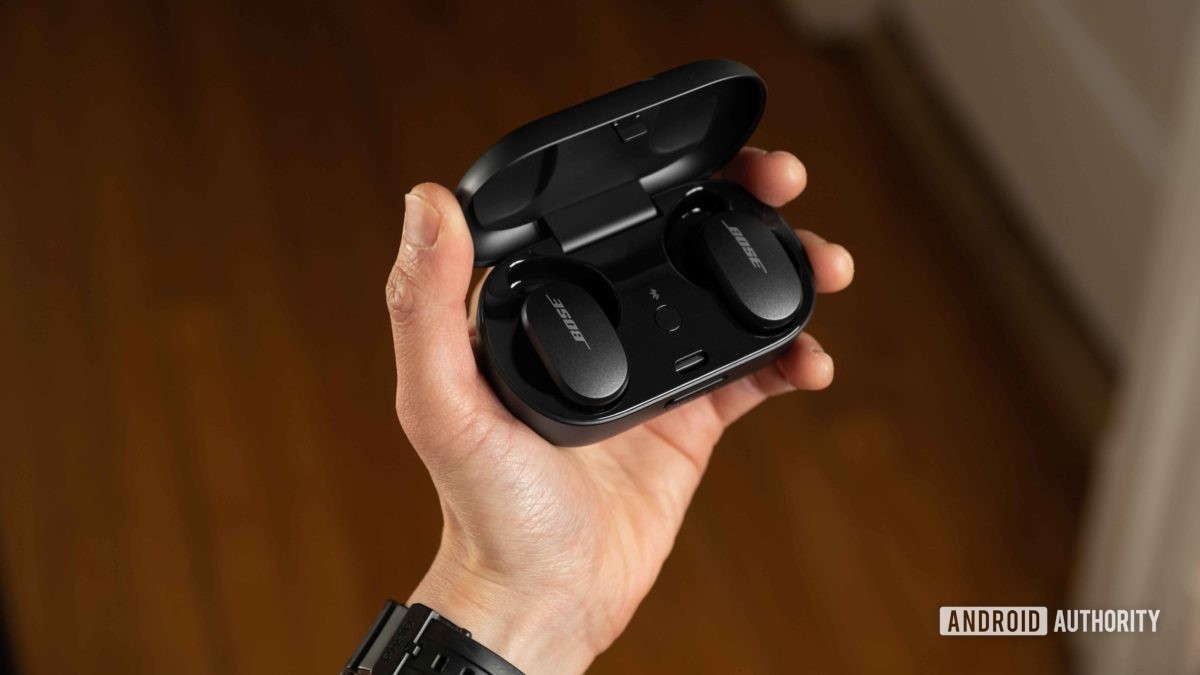
A hand holds the Bose QuietComfort Earbuds noise cancelling true wireless earbuds open charging case.

Credit: Lily Katz / Android Authority

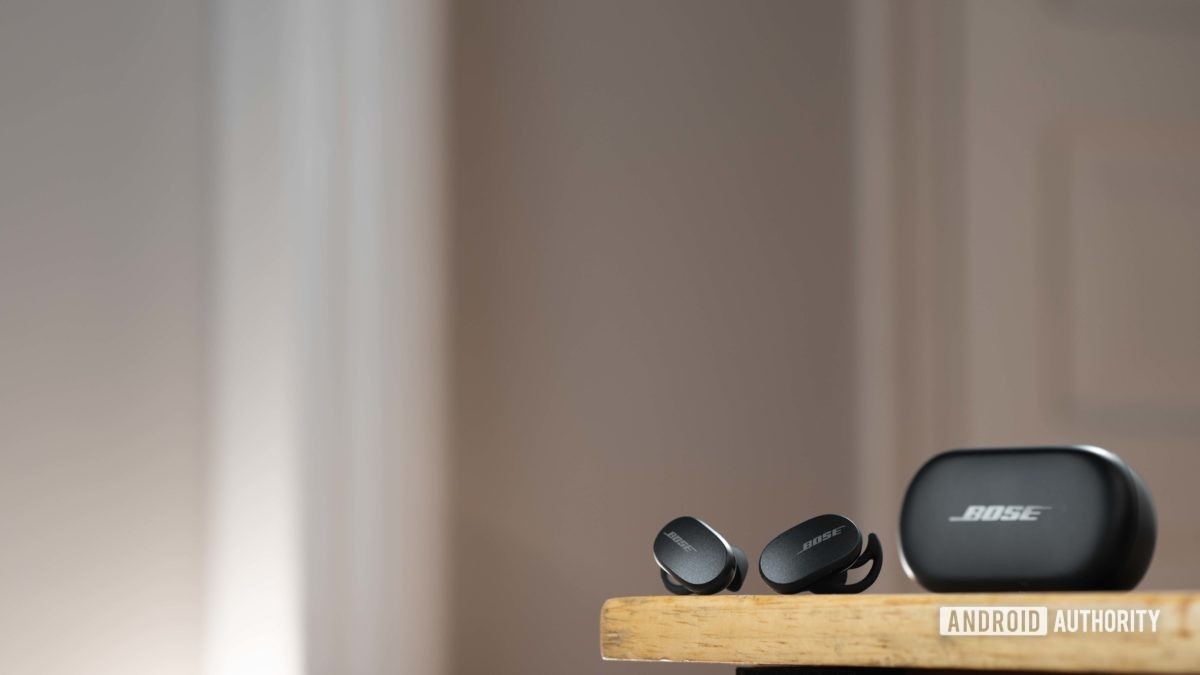
Bose’s QuietComfort Earbuds pack all of the signature style you expect from the company, even if they are a bit bulky. The overall design is pretty minimal, almost like the Bose Noise Cancelling Headphones 700. It’s sleek and curved. You can grab a pair in either black or white. Though the QC Earbuds are not without their bulk, they are slightly trimmed down from Bose’s original true wireless earbud offerings.

The QC Earbuds nestle nicely into an equally bulky charging case, which comes in black or white to match your headset. You can quickly check your remaining battery level with the four LED lights that adorn the case. Additionally, an internal button is available to manually activate pairing mode. You may want to keep a cleaning cloth close at hand, however — the case collects oil very quickly.

See also: The best true wireless earbuds

The Bose QuietComfort Earbuds will automatically jump into pairing mode the very first time you open the charging case. However, you will want to download the Bose Music app for the best overall experience. It’s a must-have if you want to swap between devices or adjust your ANC settings. You’ll also need the app if you want to change the onboard controls. It allows you to set three quick ANC modes, which you can cycle through with a double-tap on the left earbud.


How do you control the Bose QuietComfort Earbuds?

The Bose QuietComfort earbuds rely on touch controls and only touch controls. That means you have to learn a whole menu of taps and swipes. Unfortunately, they’re not always intuitive. Here’s a handy table to give you the lay of the land:

Action Left Side Right Side
Two taps Cycle through ANC quicksets Pause or play music
Pickup or end phone call
Hold (Long press) Skip song Access smart assistant
Check battery level Reject phone calls
Remove or insert Pause or play music Pause or play music
Auto Transparency mode Auto Transparency mode
Swipe Volume up or down

What Bluetooth codecs do the Bose QuietComfort Earbuds support?

The Bose QuietComfort Earbuds noise cancelling true wireless earbuds rest next to the closed charging case on a wood surface.

Credit: Lily Katz / Android Authority

Like its half-siblings, the Bose Sport Earbuds, the QuietComfort Earbuds rely on Bluetooth 5.1. They work well within the recommended range. You should have no problems either indoors or outdoors, as long as you stay within about nine meters of your connected device.

See also: What are the best noise-canceling earbuds?

The new buds also match the rest of the Bose lineup with support for two main Bluetooth codecs: SBC and AAC. That’s great news for Apple users, as iOS pairs perfectly with the powerful AAC codec. However, it’s not as reliable on Android. If you find yourself struggling with streaming quality, you can always revert your buds to an SBC connection through your Android device’s developer options.

What’s the difference between Bluetooth 5.0 and Bluetooth 5.1?

Bluetooth 5.1 offers slightly more accurate location tracking than Bluetooth 5.0. This means your phone has an easier time determining the exact location of your Bose earbuds. It’s great if you have a find my earbuds feature, though version 4.2.4 of the Bose Music app doesn’t offer it.

The newer version of Bluetooth is also more energy-efficient, and it’s all thanks to a better caching system. It results in quicker auto-connect speeds. Both Bluetooth 5.0 and 5.1 are part of the Bluetooth Low Energy Standard. They’re not part of LE Audio, though we will only see initial support for that in Bluetooth Core Specification 5.1.


How good is the battery life?

The Bose QuietComfort Earbuds noise cancelling true wireless earbuds rest outside of the open charging case.

Credit: Lily Katz / Android Authority

As usual, we put the Bose QuietComfort Earbuds through a constant 75dB output until the batteries emptied. They managed five hours and 29 minutes of playback with ANC enabled. We found this to be above average for ANC true wireless earbuds, topping the likes of both the AirPods Pro and Sony WF-1000XM3.

Additionally, Bose’s QuietComfort Earbuds support fast charging. So, about 15 minutes in the charging case should get you two hours of playback. If you need to recharge from scratch, you’re looking at about two hours. The case itself takes three hours to charge via USB-C, or you can charge with a Qi wireless mat at whatever speeds your pad can handle.


How do the Bose QuietComfort Earbuds sound?

Bose QuietComfort Earbuds AA frequency response chart

The Bose QC Earbuds sound decent, though the frequency response won’t score many points with audiophiles. Bass notes get a hearty boost, nearly two-times that of the low-midrange notes. This can muffle the vocals a bit, especially during bass-heavy songs. While audiophiles may not rejoice, most average consumers will be pleased with the bass power for the extra kick it offers.

See also: Working from home? 5 noise-canceling headphones we recommend picking up

Like any headset, your sound quality is pretty dependent on getting the right fit. Luckily, Bose includes three ear tip sizes with each pair of earbuds, which should work for most ears. You’ll want to try for the perfect fit both to enhance your noise-canceling and to maintain as much of the bass reproduction as possible.


Do the Bose QuietComfort Earbuds have good noise-canceling?

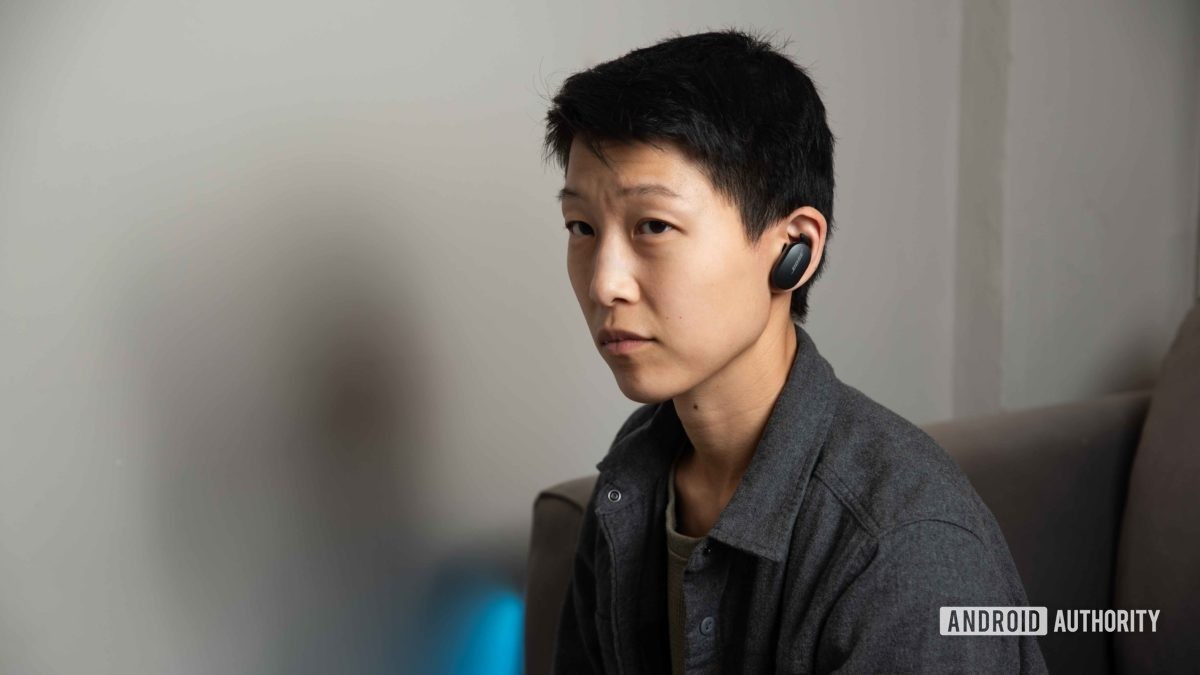
A woman wears the Bose QuietComfort Earbuds noise cancelling true wireless earbuds.

Credit: Lily Katz / Android Authority

If you travel or commute often, the QuietComfort Earbuds’ ANC option is the icing on your cake. It works surprisingly well to tackle sounds like the hum of an airplane or the racket of an engine. I was pleasantly impressed by how well the earbuds knocked out the sounds of my stationary bike. Normally when I’m pedaling away, my entire apartment rattles. Yet, I hardly noticed any sound when I maxed out the ANC settings.

See also: The best noise-cancelling true wireless earbuds

You can adjust your noise cancelling from levels 1 to 10 on a handy sliding scale. The same scale also manages your transparency, so the lower you set the ANC, the more you increase the audio passthrough. It may take some getting used to, but the ambient noise settings are very impressive compared to other options on the market. I actually prefer the QuietComfort Earbuds’ transparency settings to those of the Sony WF-1000XM3.

Of course, Bose’s ANC isn’t a miracle worker. It won’t do much good against incidental noise like slamming a door or dropping a plate. If you want to tackle the most sound, you just have to make sure that you get a good seal with your ear tips.


How good is the onboard microphone?

You should have no problems with Bose’s microphone system. It’s good enough to get you through just about any phone call with ease. We had no problems with intelligibility. However, there was occasionally a bit of audio clipping. The earbuds use ANC effectively to eliminate noise like the humming of a microphone, as you’ll hear in the demo below. Give it a listen and let us know what you think of the quality.

Bose QuietComfort Earbuds microphone demo:


Bose QuietComfort Earbuds vs Bose Sport Earbuds

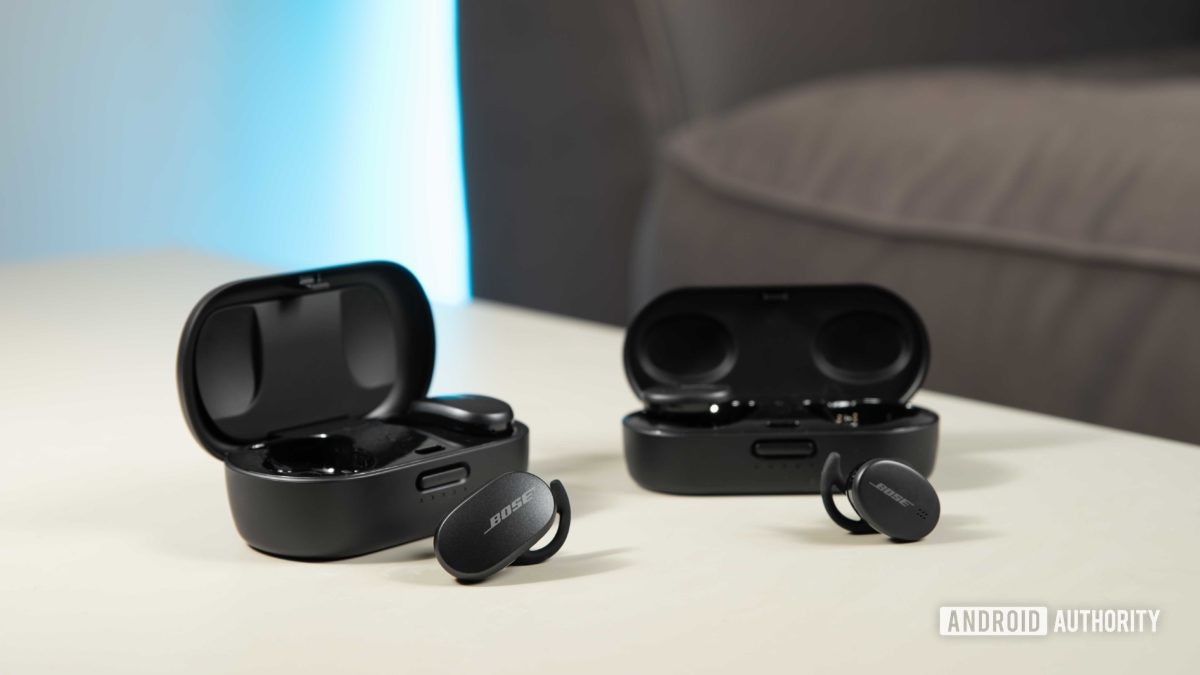
The Bose QuietComfort Earbuds noise cancelling true wireless earbuds next to the Bose Sport Earbuds for a size comparison.

Credit: Lily Katz / Android Authority

Bose’s QuietComfort Earbuds and Sport Earbuds are close cousins. Nevertheless, the two are meant for slightly different audiences. The Sport Earbuds lack noise cancelling and are meant specifically for athletes even though anyone can use them. That’s about where the differences end. Both pairs use the StayHear Max ear tips, both use onboard touch controls, and both charge via USB-C.

See also: Bose Sport Earbuds Review

Both pairs of earbuds also share the same IPX4 rating. This begs the question why not just get the QuietComfort Earbuds for both commuting and working out? You certainly can do that, but it depends on how dedicated you are to ANC. The Sport Earbuds offer decent passive isolation, and maybe you just don’t want to shell out the extra cash for ANC features. Bose’s added noise-cancelling technology also adds most of the QC Earbuds’ bulk, which may make them uncomfortable in the gym.

You may also want to consider a few differences before you make a purchase. For starters, the Bose QuietComfort Earbuds support wireless charging in case your USB-C input is faulty. You’ll also get a few extra minutes of battery life on the QC Earbuds, even with ANC on. However, you can save yourself $100 if you skip the noise-cancelling features and grab the Sport Earbuds. If you don’t absolutely need the ANC features, you may be best off saving some money.

See also: The best true wireless workout earbuds you can buy


Bose QuietComfort Earbuds review: The verdict

The Bose QuietComfort Earbuds noise cancelling true wireless earbuds rest outside of the charging case on a table and in front of a stack of books.

Credit: Lily Katz / Android Authority

Bose’s QuietComfort Earbuds are a great pick for just about anyone, as long as you have the money to spend. You won’t really need any other earbuds for your commute, work, or the gym.

The flat, sleek design will appeal to most people, though the large earbud housings might not be so popular. The charging case is large as well, at least compared to other true wireless earbuds. You may want to keep that in mind if you’re tight on pocket space. Of course, the price is hard to swallow for most of us, which is the biggest hurdle. However, Bose often puts its premium headsets on promotion, so you may just want to wait a while for a sale.

Bose QuietComfort Earbuds Bose's first noise-canceling true wireless earphones.
The Bose QC Earbuds feature an IPX4 rating, effective noise-cancelling, and a comfortable design. If you want a pair of comfortable earbuds that work with iOS and Android, look no further.

iPhone users may still prefer the Apple AirPods Pro

A picture of the Apple AirPods Pro earbuds in a man's open hand with an iPhone in the background.

If you call iOS home and you’re not sold on the QuietComfort Earbuds, fear not — you can always grab a pair of Apple’s own AirPods Pro for a bit less money. Even though the QuietComfort Earbuds offer a solid experience on both iOS and Android, you’ll have to download Bose Music which adds an extra step compared to the AirPods Pro.

The AirPods Pro offers good noise-canceling, a far more compact design, and all of the power of the H1 chip. You’re talking hands-free Siri access, device switching, Spatial Audio, and more. Apple’s premium buds are also IPX4 rated, so they’ll work well in the gym. Battery life might take a hit, but you spend most of the time in the charging case anyway.

Apple AirPods Pro
Grab the ultimate pair of Apple headphones and enjoy the added power of the Pro name. With an improved charging case and silicone ear tips, you can listen all day with ease and comfort.
NEWSLETTER | Review Alerts

Get all the latest reviews

Join our most passionate readers to get instant access to tech reviews as they arrive!

By signing up, you agree to our Terms of Use and acknowledge the data practices in our Privacy Policy. You may unsubscribe at any time.


from Android Authority https://ift.tt/3iZRwqV